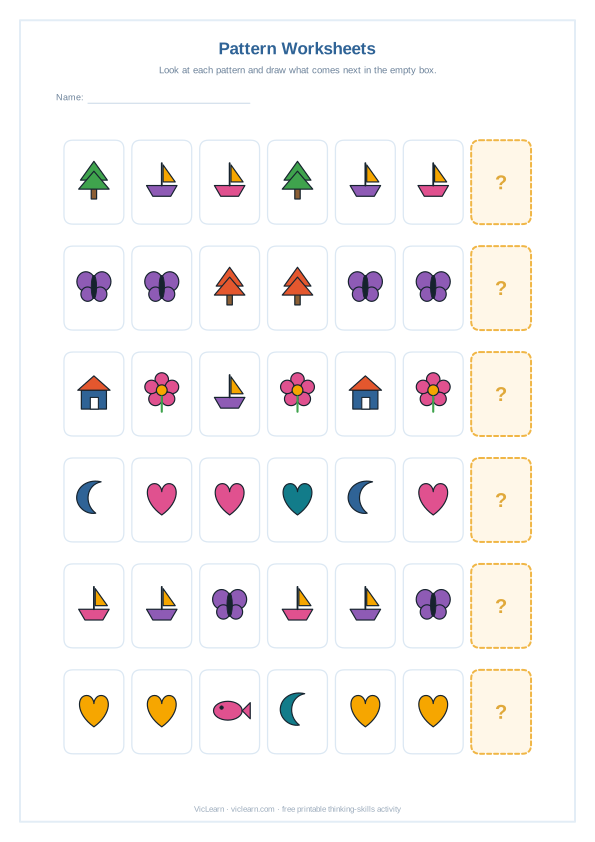

Pattern Worksheets for Kids — Ages 8–9 (Free PDF with Answer Key) is a free printable made by VicLearn. Download the ready-to-print A4 PDF below — no sign-up, no redirect to other sites, no watermark.
Download PDF (A4)
Download PNG
Print now
What is inside
Illustrated pattern strips (AB, ABC, growing) with the last box empty to draw what comes next. Answer key on page two.
How to use it
- Download the PDF and print it on A4 or US Letter paper (fit to page).
- For a whole class, print one copy and photocopy it — the lines stay crisp because the file is vector, not a photo.
- Laminate it or slip it into a plastic sleeve to reuse with dry-erase markers.
Free for classroom and home use. Please do not resell the file.
Other sheets in this collection
Same skill, different difficulty. Print one, not all — a finished page beats five abandoned ones.
- Pattern Worksheets for Kids — Ages 6–7 (Free PDF with Answer Key)Open sheet →
- Pattern Worksheets for Kids — Ages 4–5 (Free PDF with Answer Key)Open sheet →
Pick the right level
| Level | Best for | Start with | Move up when |
|---|---|---|---|
| Pre-K (3–4) | Pencil control, thick strokes | The simplest sheet in the set | The child finishes a row without help |
| Kindergarten (5) | Single letters, numbers, shapes | Dotted model with direction arrows | Letters stay on the baseline |
| 1st grade (6) | Words, short sentences, 2-step tasks | Double-ruled sheet | Fewer than 2 errors per row |
| 2nd grade (7+) | Fluent writing and reasoning | Free practice / challenge sheet | The child asks for a harder page |
How to check the work
- Check direction before beauty: a letter drawn top-to-bottom is correct even if it looks shaky.
- Mark only two errors per page. More than that and the child stops reading your marks.
- For puzzle sheets, the answer key is the last page of the PDF — print it separately and keep it aside.
- Re-print the same sheet after two weeks and compare: that comparison is the real progress report.
Print checklist (30 seconds)
- Paper: plain A4 or US Letter, 90–120 g/m² so markers do not bleed through.
- Printer setting: “Actual size” / 100% — “Fit to page” shrinks the guide lines.
- Black & white is enough; save colour ink for the reward pages.
- Slide the page into a plastic sleeve to reuse it with a dry-erase marker.
Frequently asked questions
Is Pattern Worksheets for Kids — Ages 8–9 (Free PDF with Answer Key) free?
Yes. View it, print it and download the PDF with no sign-up and no watermark.
Can I use it in my classroom?
Yes. This collection has 3 sheets to rotate through the school year.
How much practice per day?
Six to ten focused minutes a day beats one long session at the weekend.
Do I need a colour printer?
No. Every sheet is designed to print clearly in black and white.
Is there an answer key?
Challenge sheets include the answer key on the last page of the PDF.
Why this sheet works
Patterns are the first algebra a child ever meets. Before letters stand for numbers, a red-blue-red-blue strip teaches the same idea: something repeats, and you can predict what comes next. Children who read patterns fluently pick up skip counting and multiplication faster, because both are patterns wearing a different costume.
How to use it, step by step
- Read the strip out loud together: “circle, square, circle, square…”. Naming the unit is half the work.
- Ask what comes next before any pencil touches the page.
- Let the child draw or colour the missing item, then re-read the whole strip to check.
- Cover the strip and ask them to rebuild it from memory with blocks, buttons or pasta.
- Finish with one invented pattern of their own on the back of the sheet.
Three ways to make it harder (or easier)
- Easier: cut the strip so only the last item is missing.
- Harder: switch from AB to ABB or ABC units, or leave a gap in the middle instead of the end.
- Much harder: growing patterns — one, then two, then three — which lead straight into number sequences.
Mistakes that ruin the activity
- Correcting the answer before the child has read the strip aloud; the reading is the skill.
- Doing every row in one sitting. Two rows done thoughtfully beat a full page rushed.
- Treating colour as decoration — the colour is the pattern, so keep printouts consistent.
Age and level guide
| Age | What to expect | Time on task | Ready for more when |
|---|---|---|---|
| 3–4 | Needs an adult reading each instruction out loud | 5–8 minutes | The child points to the answer before you finish reading |
| 5–6 | Works alone in short bursts, asks to check | 8–12 minutes | Two sheets in a row with no help |
| 7–8 | Reads and solves independently | 12–18 minutes | Finishes early and looks bored |
| 9+ | Wants a rule to bend or a timer to beat | 15–20 minutes | Starts inventing their own version |
Frequently asked questions
What age is this for?
Roughly 3 to 7, though the harder ABC and growing patterns keep 8-year-olds busy.
Is colour printing required?
No. Shapes carry the pattern; the child can colour it in themselves.
How does this help with maths?
Pattern recognition is the base of skip counting, times tables and early algebraic thinking.
Explore the topic
More in this topic
Get the complete pack of this set — free
One email, one link, all the sheets of this topic in a single PDF. No spam, unsubscribe in one click.
What you need to print this well
- Bright white printer paper (24 lb)Markers stop bleeding through at 24 lb / 90 g.
- Dry-erase pocketsTurn one printed sheet into unlimited practice.
- Triangular beginner pencilsFixes the grip before the handwriting habit sets.
- Laminator + pouchesFor the charts and cards you will reuse all year.
Links to Amazon. If you buy through them we earn a small commission at no extra cost — it keeps every sheet on this site free.
Want the printer-ready mega packs? See the printable packs.