Why number bonds are worth more than counting practice, how to sequence them, and two free bond printables to download.
Type your child’s name and print a custom tracing worksheet in seconds — free, no sign-up.
Make my worksheet →
Free number bonds worksheets to download
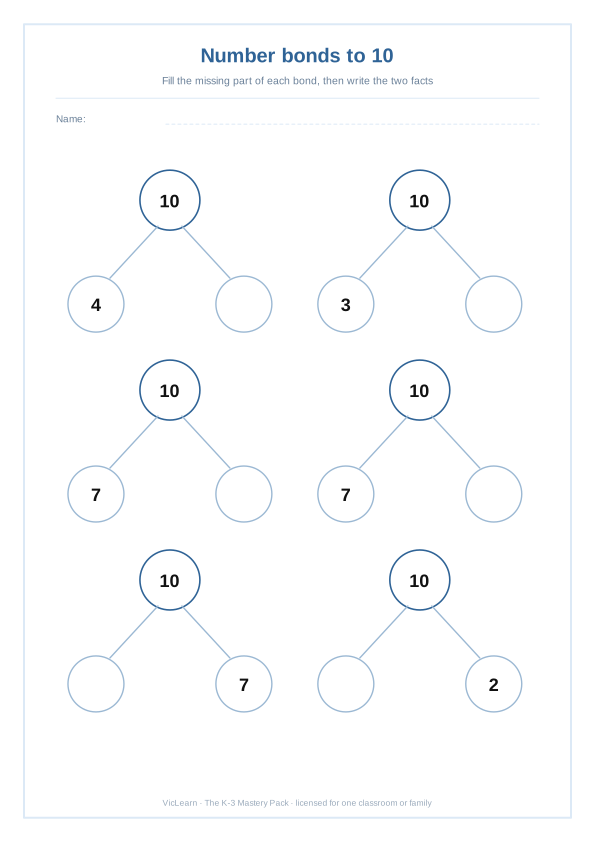
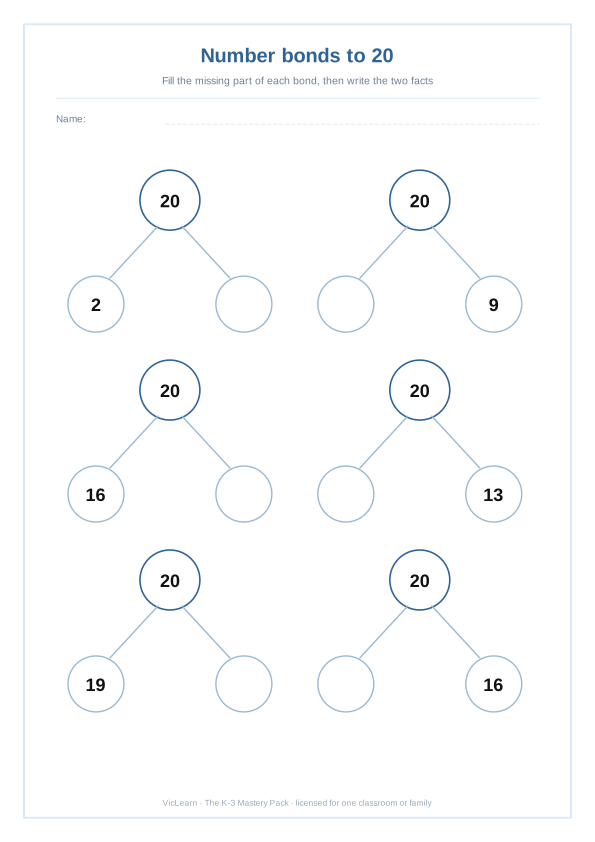
Two ready-to-print A4 sheets, drawn as vectors by VicLearn — no sign-up, no watermark, no redirect to another site.
Why bonds outperform counting on
A child who counts on their fingers to solve 7 + 5 is doing eleven operations. A child who knows 7 + 3 = 10 solves it in one step: 7 + 3 = 10, plus 2 more, 12. Number bonds are what makes that second route possible, and they are the difference between arithmetic that scales and arithmetic that jams at two digits.
Only six facts to learn for 10
The bonds to 10 look like ten facts but commutativity halves the work:
| Bond | Also gives you | Teach in week |
|---|---|---|
| 0 + 10 | 10 + 0 | 1 |
| 1 + 9 | 9 + 1 | 1 |
| 2 + 8 | 8 + 2 | 1 |
| 3 + 7 | 7 + 3 | 2 |
| 4 + 6 | 6 + 4 | 2 |
| 5 + 5 | the anchor fact | 2 |
Then use them: bridging through ten
Bonds are only worth learning if they get used. Bridging is the payoff: to solve 8 + 6, take 2 from the 6 to make 10, then add the remaining 4. Make this explicit and practise it as its own skill, otherwise children keep the bonds memorised and keep counting anyway.
Subtraction uses the same facts backwards: 13 − 5 becomes 13 − 3 = 10, then − 2 = 8.
Fluency benchmark
Aim for all bonds to 10 answered in under three seconds each, and bonds to 20 in under five. Test them out of order and orally — a written page lets a child count in the margin and hides the gap.
Frequently asked questions
What age are number bonds to 10?
Kindergarten to first grade, roughly ages 5–6, with bonds to 20 in first and second grade.
Part-part-whole or ten frames?
Both, in that order. Ten frames make ‘how many more to fill it’ visual; the part-part-whole diagram then abstracts it into the form used in written arithmetic.
Is memorising the facts enough?
No — a child can recite bonds and still count on fingers for 8 + 6. Always finish with bridging problems that force the bond to be used.
Want the full sequence in one file? The K-3 Mastery Pack collects 58 worksheets across all of these skills in a single PDF. Everything on this page stays free either way.
Everything on this page is drawn as vector line work, so it prints sharp at any size. Here is exactly what this math activity trains and how to get the most out of one printed copy.
What your child actually practices here
- Number sense: mixed problems stop the child from answering on autopilot.
- Self-checking: the answer line encourages the child to review before saying the result out loud.
- Stamina: a full page done calmly builds the endurance timed tests demand later.
- Fact fluency: repeating the same family of operations shortens recall time without memorization drills.
Best age range and how to adapt it
- 3 to 4 years: expect an adult to work alongside the child and to finish only part of the page — that is a complete session at this age.
- 5 to 6 years: the child should manage the sheet alone in about ten minutes and want to show the result.
- 7 years and up: use it as a warm-up before harder work, or ask for a personal variation (new colors, an invented title, a second page).
What you need
- A4 or US Letter paper (plain 75g is enough — the file is vector, so it stays sharp)
- A pencil, or thick crayons for children under five
- Optional: a plastic sleeve or laminating pouch plus a dry-erase marker to reuse the sheet
A 15-minute plan you can follow today
- Set up: table cleared, one pencil, no screen in the line of sight.
- Work: one single sheet. Two pages in a row is the fastest way to turn a good activity into a chore.
- Close: ask the child to explain what they did — the explaining is where the learning is consolidated.
Five ways to reuse the same sheet
- Turn three problems into a small story problem told out loud.
- Do half today and half tomorrow to check what was actually retained.
- Ask the child to write one extra problem of their own at the bottom.
- Correct together, out loud, without a red pen.
- Laminate and repeat weekly to measure speed, not only accuracy.
Common mistakes (and the quick fix)
- Printing at reduced scale: always choose “fit to page” or “actual size”; shrinking the sheet makes the lines too tight for small hands.
- Correcting every stroke: pick one point of feedback per session and let the rest go.
- Doing several sheets in a row: the second page is almost always worse than the first.
Frequently asked questions
Is this number bonds to 10 and 20: the fact fluency shortcut (+ pdfs) printable really free?
Yes. The PDF downloads directly, with no sign-up, no email and no watermark. You can use it at home and in the classroom.
Can I print it for my whole class?
Yes. Print one copy and photocopy it, or print as many as you need. The only restriction is reselling the file itself.
What paper size should I use?
The file is built for A4 and prints perfectly on US Letter as well — just keep the printer on “fit to page”.
Will it print well in black and white?
Yes. Everything is vector line work, so a plain black-and-white laser or inkjet printer gives a clean result.
Can I reuse the same sheet?
Put it inside a plastic sleeve or laminate it and use a dry-erase marker. One print then lasts for months.
Keep a folder with the finished sheets. Progress in handwriting and attention is only visible when you compare two weeks apart.
- CVC Words Worksheets: Blending, Word Families and the Order to Teach (+ Free PDFs)
- Handwriting Practice Sheets: Grip, Letter Order and Fixing Reversals (+ Free PDFs)
- Place Value Worksheets: Tens, Hundreds and Why Regrouping Breaks (+ Free PDFs)
- Telling Time Worksheets: The Hour-to-Minute Progression (+ Free PDFs)
- Sight Words Worksheets: How to Teach the First 100 Words (+ Free PDFs)
Leia também
Explore the topic
More in this topic
Get the complete pack of this set — free
One email, one link, all the sheets of this topic in a single PDF. No spam, unsubscribe in one click.
What you need to print this well
- Bright white printer paper (24 lb)Markers stop bleeding through at 24 lb / 90 g.
- Dry-erase pocketsTurn one printed sheet into unlimited practice.
- Triangular beginner pencilsFixes the grip before the handwriting habit sets.
- Laminator + pouchesFor the charts and cards you will reuse all year.
Links to Amazon. If you buy through them we earn a small commission at no extra cost — it keeps every sheet on this site free.
Want the printer-ready mega packs? See the printable packs.