A teacher-style guide to sequencing Dolch sight words, plus two free printable practice sheets you can download here.
Type your child’s name and print a custom tracing worksheet in seconds — free, no sign-up.
Make my worksheet →
Free sight words worksheets to download
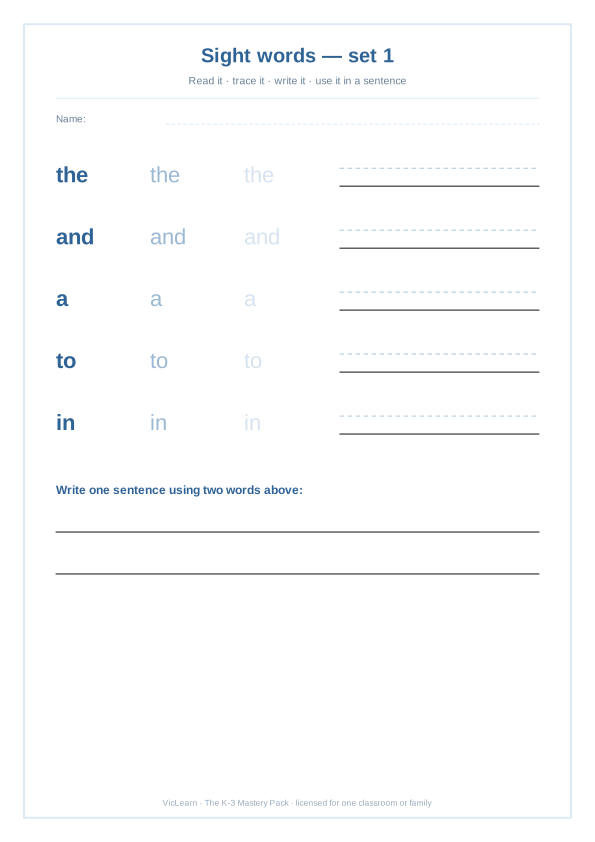
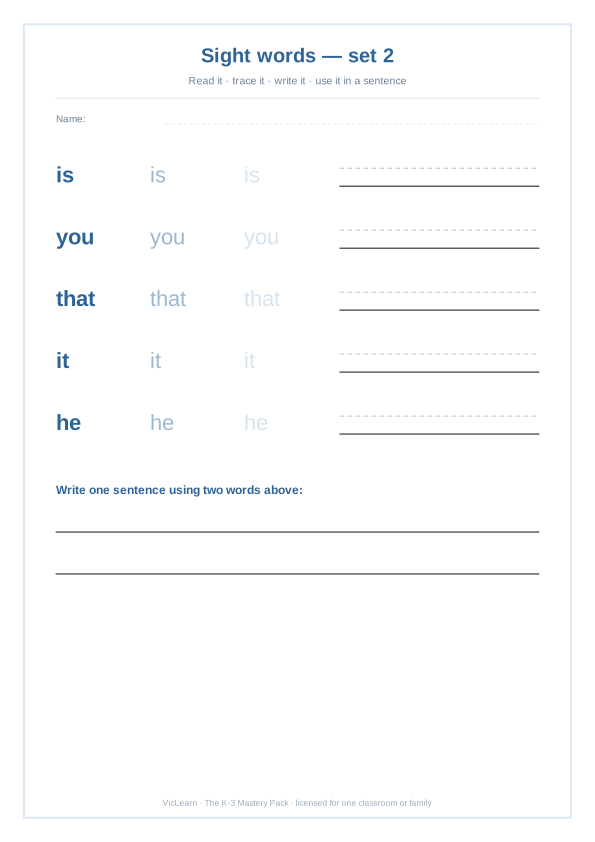
Two ready-to-print A4 sheets, drawn as vectors by VicLearn — no sign-up, no watermark, no redirect to another site.
What sight words actually are (and what they are not)
Sight words are the high-frequency words a child should read instantly, without sounding them out. Around 100 words make up roughly half of everything printed in a beginner book, which is why fluency jumps so sharply once they are automatic.
They are not a replacement for phonics. Words like and, can and stop are perfectly decodable — they are on the list because they are frequent, not because they are irregular. Only a handful (the, said, was, one) genuinely break the rules and need to be memorised as wholes.
The order that works: five words a week
Five new words per week is the pace most classrooms settle on. It is slow enough that nothing is forgotten by Friday and fast enough to finish the first 100 in a school year. Each set below is one week.
| Week | Words | Focus |
|---|---|---|
| 1 | the, and, a, to, in | Pure recognition — no writing pressure |
| 2 | is, you, that, it, he | Read in a sentence, not in isolation |
| 3 | was, for, on, are, as | Introduce the irregular spelling of was |
| 4 | with, his, they, at, be | Mix weeks 1–4 in a review pile |
| 5 | this, have, from, or, one | Speed round: 10 words in 60 seconds |
| 6 | had, by, but, not, what | Write two sentences using four words |
The four-step routine for each word
- See and say. Show the word, read it aloud, the child echoes it. Two seconds, no discussion.
- Trace. Muscle memory locks the letter order in a way that reading alone does not.
- Write from memory. Cover the model and write it. This is the step most worksheets skip and the one that actually transfers.
- Use it. The child says or writes one sentence with the word. A word that never leaves the flashcard never becomes reading.
Common mistakes that stall progress
- Teaching 20 words at once. Recall collapses above ~7 new items; the child looks like they regressed when they were simply overloaded.
- Flashcards only. Recognition on a card does not transfer to a page of text. Always finish in connected text.
- Dropping mastered words. Old words need to keep appearing in the review pile for 4–6 weeks or they fade.
- Correcting instantly. Wait three seconds before supplying the word — that pause is where retrieval is built.
How to know a word is mastered
The working benchmark is three correct readings on three different days, inside a sentence, in under one second. Anything slower is still decoding, not sight reading. Keep a simple tally sheet; children respond strongly to seeing the pile of retired words grow.
Frequently asked questions
At what age should sight words start?
Most children are ready once they know the majority of letter sounds — typically around age 5, at the start of kindergarten. Starting earlier rarely helps and often creates guessing habits.
How many sight words should a kindergartener know?
A common end-of-kindergarten target is 50 words, and 100–150 by the end of first grade. Pace matters far more than the number: five secure words beat twenty shaky ones.
Dolch or Fry list?
Dolch (220 words) is grouped by grade and is the easier place to start. Fry (1,000 words) is ordered by frequency and is more useful from second grade onwards. The first 100 overlap heavily, so the choice barely matters early on.
Want the full sequence in one file? The K-3 Mastery Pack collects 58 worksheets across all of these skills in a single PDF. Everything on this page stays free either way.
This Sight Words Worksheets: How to Teach the First 100 Words (+ PDFs) sheet is designed for one short session: print it, hand it over and expect it to be finished in about ten minutes. Below you will find what the child practices, how to run the activity, and five ways to reuse the same page.
What your child actually practices here
- Turn-taking and rules: playing with someone else adds the social layer worksheets never have.
- Working memory: remembering where a card was is a direct exercise for the memory used in reading.
- Vocabulary: every card is named out loud, several times, in a natural way.
- Motivation: a game finishes with a win, not with a corrected page.
Best age range and how to adapt it
- Preschool: shorten the goal — half the page, no time pressure, and stop while the child is still enjoying it.
- Kindergarten: perfect fit; this is the level the sheet was designed for.
- Early elementary: raise the bar by adding a timer, a story about the picture, or a written sentence underneath.
What you need
- A4 or US Letter paper (plain 75g is enough — the file is vector, so it stays sharp)
- A pencil, or thick crayons for children under five
- Optional: a plastic sleeve or laminating pouch plus a dry-erase marker to reuse the sheet
A 15-minute plan you can follow today
- Minute 1-2: print the sheet and say out loud what you are going to do, so the child knows where the activity ends.
- Minute 3-10: the child works; you stay nearby but silent unless asked. Interrupting breaks concentration more than a wrong stroke does.
- Minute 11-13: review it together, pointing at one thing that came out well before anything to fix.
- Minute 14-15: put the sheet somewhere visible. Finished work on display is what makes the child ask for the next one.
Five ways to reuse the same sheet
- Use the cards as flashcards outside the game.
- Let the child be the one who explains the rules to someone else.
- Play with fewer cards for younger children, more for older ones.
- Play cooperatively: everybody against the clock instead of against each other.
- Name each card out loud in a second language.
Common mistakes (and the quick fix)
- Using thin pencils with very young children: a thicker pencil or crayon gives a more stable grip.
- Turning the activity into a test: no scores, no comparisons with siblings.
- Throwing the sheet away at the end: keeping a folder shows visible progress over weeks.
Frequently asked questions
Is this sight words worksheets: how to teach the first 100 words (+ pdfs) printable really free?
Yes. The PDF downloads directly, with no sign-up, no email and no watermark. You can use it at home and in the classroom.
Can I print it for my whole class?
Yes. Print one copy and photocopy it, or print as many as you need. The only restriction is reselling the file itself.
What paper size should I use?
The file is built for A4 and prints perfectly on US Letter as well — just keep the printer on “fit to page”.
Will it print well in black and white?
Yes. Everything is vector line work, so a plain black-and-white laser or inkjet printer gives a clean result.
Can I reuse the same sheet?
Put it inside a plastic sleeve or laminate it and use a dry-erase marker. One print then lasts for months.
If this sheet worked well, the same idea repeats across the whole VicLearn library: one clear objective per page, printed in seconds and finished before the child loses interest.
- Kindergarten Readiness Checklist: What Actually Matters (+ Free Printable)
- Addition and Subtraction With Regrouping: Teaching Carrying and Borrowing (+ Free PDFs)
- Skip Counting Worksheets: The Bridge From Counting to Times Tables (+ Free PDFs)
- Number Bonds to 10 and 20: The Fact Fluency Shortcut (+ Free PDFs)
- CVC Words Worksheets: Blending, Word Families and the Order to Teach (+ Free PDFs)
Explore the topic
More in this topic
Get the complete pack of this set — free
One email, one link, all the sheets of this topic in a single PDF. No spam, unsubscribe in one click.
What you need to print this well
- Bright white printer paper (24 lb)Markers stop bleeding through at 24 lb / 90 g.
- Dry-erase pocketsTurn one printed sheet into unlimited practice.
- Triangular beginner pencilsFixes the grip before the handwriting habit sets.
- Laminator + pouchesFor the charts and cards you will reuse all year.
Links to Amazon. If you buy through them we earn a small commission at no extra cost — it keeps every sheet on this site free.
Want the printer-ready mega packs? See the printable packs.