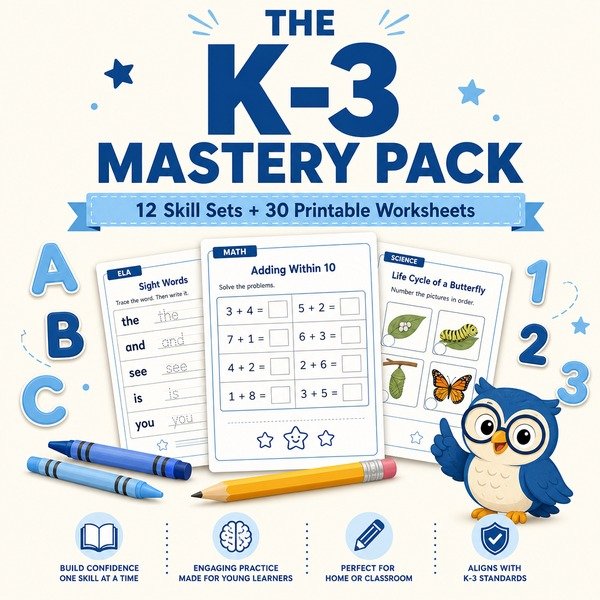
The K-3 Mastery Pack: 12 Ready-to-Print Skill Sets
Essential Literacy and Math Foundations for Early Learners
56 printable pages
You will gain a comprehensive, ready-to-use resource library that replaces hours of lesson planning with targeted, classroom-tested student activities.
How to use this pack
- 01Print
A4 or US Letter, “Fit to page”, black & white is enough. Every sheet is designed low-ink — no full-bleed colour, no wasted toner.
- 02Reuse
Slip a sheet into a plastic sleeve or laminate it and use a dry-erase marker. One page becomes a hundred repetitions.
- 03Rotate
Pick two or three sheets a week, not twenty. Consistency beats volume — 10 to 15 minutes a day is the whole method.
- 04Keep
Punch and file finished pages in a ring binder. By the end you have a portfolio that shows real progress.
Your licence. 56 printable pages for personal or single-classroom use. Print as many copies as you need for your own children or your own students. Please don’t resell, share the file, or upload it to a shared drive — VicLearn is a small studio and every purchase pays for the next pack.
Your 4-week plan
Each chapter ends with a task box. Do the task the same day you read the chapter, print the matching worksheets from the bonus annex, and tick the box. Four weeks is all it takes to run the whole pack.
| When | Chapters | Workload |
|---|---|---|
| Week 1 | Foundational Pencil Control; Personalized Name Recognition Drills; Phonics Blending Strategies | 6 worksheets · 10–15 min/day |
| Week 2 | Advanced Multisyllabic Decoding; High-Frequency Sight Word Mastery; Early Literacy Foundations | 6 worksheets · 10–15 min/day |
| Week 3 | Multiplication Fact Fluency; Interactive Learning Flashcards; Preschool Cognitive Readiness | 6 worksheets · 10–15 min/day |
| Week 4 | Structural Preschool Engagement; Early Years Skill Development; Calibrated Handwriting Practice | 6 worksheets · 10–15 min/day |
Foundational Pencil Control
Most teachers rush students directly into alphabet tracing. This is a mistake. When children attempt letter formation without mastering complex curves and directional changes, they compensate by locking their wrists or pressing too hard. This creates a permanent, rigid grip that leads to chronic fatigue by grade three.
Complex shapes—spirals, zig-zags, and intersecting loops—force the hand to navigate spatial constraints that simple letters do not. By training the small muscles of the hand through these patterns first, you build the fluid range of motion required for effortless penmanship later. Do not skip this phase.
| Skill | Grade | Minutes | Mastery Goal |
|---|---|---|---|
| Continuous Spirals | K | 7 | Uniform spacing, no paper tearing. |
| Intersecting Zig-Zags | 1 | 10 | Sharp vertices, no rounding corners. |
| Complex Wave Loops | 2-3 | 12 | Consistent baseline, fluid wrist glide. |
Follow these four steps to implement the worksheets:
- Air-Writing: Students trace the pattern in the air with a straight index finger for 60 seconds to internalize the movement trajectory.
- Dry Tracing: Use a plastic sheet protector over the worksheet. Have students trace the shapes with a dry-erase marker. The low friction of the marker helps them focus on pathing rather than pressure.
- Pencil Execution: Move to the paper. Limit this to 10 minutes total. Fatigue sets in after 12 minutes, which is when bad habits solidify.
- The Pressure Check: Flip the paper over. If the child has indented the paper so deeply it is visible on the backside, they are using too much force. Have them switch to a 2B pencil for better feedback.
What to watch for
- The “Death Grip”: If the knuckles are white, the pencil is held too close to the lead. Have the student place a small pom-pom in their palm, held by the ring and pinky fingers. This forces the tripod grip to relax.
- Wrist Pivoting: Children often move their entire arm rather than using their wrist. Place a small binder clip on the desk to act as a “gate.” They must keep their wrist behind the gate while navigating the shape.
- Fragmented Strokes: If the student stops every half-inch to reset their grip, they lack fluid motor control. Require them to complete the entire line without lifting the pencil. If they fail, return to the “Air-Writing” phase.
Make it yours
For struggling learners: Increase the line thickness on the printed sheets to 4pt. Use a highlighter to trace the path first, then have the child trace over your yellow line with their pencil. This provides a visual anchor that reduces anxiety.
For advanced small groups: Introduce a “rhythm constraint.” Play a metronome at 60 beats per minute. The student must reach a specific checkpoint on the worksheet with every fourth beat. This forces them to regulate speed, preventing the “rush and scribble” behavior common in high-ability learners.
Do this tomorrow · 15 minutes
Run a 5-minute pencil control circuit — It builds the fine motor muscles required for legible letter formation.
- Print 3 different maze or wavy-line tracing sheets.
- Set a timer for 5 minutes of focused tracing.
- Have students complete 2 full sheets using a tripod grip.
☐ Done · you know it worked when: The student traces lines within the boundaries without lifting their pencil.
Personalized Name Recognition Drills
Most teachers provide standard name tracing sheets with uniform letter spacing. This is a mistake. It trains students to rely on fixed visual anchors rather than internalizing the motor patterns of individual letter formation.
Parents often print generic sheets where the letters are too close together. This causes students to crowd their strokes or skip letters entirely. You need custom spacing that gradually increases the gap between letters as the student gains confidence.
| Skill | Grade Level | Minutes | Mastery Goal |
|---|---|---|---|
| Letter Formation | K-1 | 8 | 3 consecutive perfect attempts |
| Spatial Awareness | 2 | 5 | Consistent baseline alignment |
- Print with custom gaps: Use a word processor to set your font spacing (kerning) to 2 points for the first column. Increase to 5 points for the middle column. Leave 10 points of space in the final column.
- The 3-stage transition: Have students trace the 2-point spacing first. Move to the 5-point spacing for guided practice. End with the 10-point spacing to force independent formation.
- Limit repetitions: Do not exceed 5 repetitions per session. Fatigue leads to poor muscle memory. Stop at 5, even if the student is willing to continue.
- Check the baseline: Use a highlighter to draw a single, thick baseline on the page. Require every lowercase letter to touch this line. If the letter “floats,” the student must restart that specific letter immediately.
What to watch for
- The “Anchor” error: Students start by tracing the first letter but lose focus on the remaining letters. Fix: Place a small dot at the starting point of each letter. Force the pencil to lift between letters to reset the starting point.
- Inconsistent size: Students make the first letter huge and the final letter tiny. Fix: Use a vertical dashed line between letters to act as a physical barrier, keeping the letter width uniform.
- Incorrect grip: Students press too hard during the 10-point spacing phase. Fix: If the lead snaps or the paper tears, switch to a soft-grip crayon for two sessions to force a lighter touch before returning to a pencil.
Make it yours
For advanced writers: Remove the tracing font entirely. Provide only the 10-point spacing guide with dots for the starting points. This forces students to rely on their memory of the letter shape while maintaining the required spacing.
For small group intervention: Use a dry-erase sleeve over the printed sheets. This adds tactile resistance. If a student struggles with a specific letter, have them trace it in the air 3 times with their dominant hand before returning to the sheet. The added physical movement reinforces the motor pattern faster than pencil-to-paper alone.
Do this tomorrow · 15 minutes
Execute a 5-minute name tracing relay — It reinforces letter recognition through repetitive tactile practice.
- Print name cards for 5 students per group.
- Have students trace their name 3 times with a highlighter.
- Ask students to write their name once independently below the trace.
☐ Done · you know it worked when: The student correctly identifies and writes their name from memory.
Phonics Blending Strategies
Most teachers introduce CVC words in alphabetical order or by random frequency. This is a mistake. It forces students to struggle with phonemes that are physically difficult to articulate or visually confusing, like ‘b’ and ‘d’, before they have mastered the mechanics of blending.
You must teach by articulatory ease and frequency. Start with continuous sounds (m, s, f, n, r) that can be stretched. Save stop sounds (p, b, t, d, k, g) for the final position. This allows students to “slide” through the word without hitting a wall of silence between sounds.
| Skill Sequence | Grade Level | Minutes | Mastery Criteria |
|---|---|---|---|
| Continuous-Vowel-Continuous (e.g., ‘man’) | K | 7 | 3 seconds or less per word |
| Continuous-Vowel-Stop (e.g., ‘mat’) | K/1 | 10 | No pauses between phonemes |
| Stop-Vowel-Stop (e.g., ‘tap’) | 1 | 12 | Automaticity in 5 word sets |
Use the 3-2-1 rule for practice. Have the child tap the three sounds, blend them twice, and say the whole word once. Repeat this sequence for 10 words per session. If a student pauses for more than 0.5 seconds between sounds, they have not achieved the “slide” and must repeat the blending motion.
What to watch for
- The “Stop-Sound” Gap: Students often insert an ‘uh’ sound after stop consonants (e.g., “buh-a-tuh”). Correct this by modeling a “breath-only” stop. Keep the consonant sound clipped and short.
- Guessing by Initial Letter: Students look at the first letter and guess the word based on a picture or context. Cover the image. Force them to touch each dot under each letter. If they guess, point to the middle vowel immediately.
- The Vowel Swap: Students confuse short ‘e’ and short ‘i’. If this happens, stop the CVC drills. Spend 3 minutes using a “Vowel Mirror.” Show them the mouth position for ‘i’ (wide, tight smile) versus ‘e’ (relaxed, slightly open jaw).
Make it yours
For small groups of 4-6, use a “Blending Board” approach. Write three columns on a whiteboard: Column 1 (initial consonants), Column 2 (vowels), Column 3 (final consonants). Change only one letter at a time. This keeps the cognitive load on the blending mechanic rather than decoding new letters. Cycle through 15 changes in 8 minutes.
To support advanced Grade 1 learners, introduce “nonsense CVC” sets. This eliminates the reliance on sight-word memory. If they can blend ‘zot’, ‘wib’, and ‘paf’ with 100% accuracy, they are truly reading, not memorizing. Aim for 20 nonsense words in 5 minutes to test for true phonemic fluency.
Do this tomorrow · 15 minutes
Facilitate a 10-minute phonics blending drill — It bridges the gap between individual sounds and whole words.
- Write 10 CVC words on the board.
- Model blending 3 words using a finger-sliding motion.
- Have students blend the remaining 7 words in chorus.
☐ Done · you know it worked when: The student blends individual phonemes into a complete word without pausing.
Advanced Multisyllabic Decoding
Most teachers treat vowel teams like static sight words. They tell students to memorize “oa” as a unit and move on. This creates “guessers” who rely on visual memory rather than decoding logic. When students encounter long words like approach or mountain, they panic because the word is too big to sight-read.
The mistake is ignoring the syllable break before the vowel team. You must teach students to isolate the vowel team as a single grapheme within a closed or open syllable structure. If the student doesn’t see the team as a singular sound unit, they attempt to map each letter individually, which breaks the phonemic integrity of the word.
| Skill | Grade Level | Minutes | Mastery Criteria |
|---|---|---|---|
| Vowel Team Isolation | 2 | 8 | 10/10 words segmented correctly |
| Syllable Division | 2-3 | 12 | Identify vowel team vs. single vowel |
| Fluency Drills | 3 | 5 | 40+ wpm with 95% accuracy |
Follow these steps to build the habit:
- Highlighting: Give students 5 multisyllabic words. Have them underline the vowel team in red ink. This forces the eye to stop and identify the unit before pronouncing the word.
- Segmentation: Draw a vertical line between syllables. If the vowel team is in the first syllable, ask the student to pronounce only that part first.
- Blending: Combine the vowel team syllable with the remaining consonants. Perform 3 repetitions per word to solidify the motor pattern.
- Verification: Ask the student, “Which two letters make the long sound?” If they cannot point to the team, they are still guessing.
What to watch for
- The “First Vowel” Trap: Students often sound out the first letter of a team and ignore the second. Correct this by covering the second letter, then uncovering it to show the sound change.
- Ignoring Syllable Breaks: Students try to blend the vowel team with a consonant from the next syllable. Use a physical card to block the second syllable until the first is mastered.
- Over-Generalization: Students apply the “when two vowels go walking” rule to words where vowels are in separate syllables (e.g., lion). Correct this by teaching them to check if the vowels are side-by-side.
Make it yours
For Tier 2 Small Groups: Use physical magnetic tiles for the vowel teams. Have students physically pull the two letters together to form a “team” before building the rest of the word. This kinesthetic anchor prevents them from drifting back to single-letter decoding.
For Grade 3 Enrichment: Introduce “vowel team competition.” Provide 20 words containing teams like ai, ea, and ou. Give students 60 seconds to box every vowel team they find. This builds speed and trains the brain to scan for patterns automatically rather than reading letter-by-letter.
Do this tomorrow · 15 minutes
Conduct a 10-minute multisyllabic chunking activity — It prevents students from guessing words by focusing on syllable breaks.
- Select 5 two-syllable words from the current reading text.
- Draw a line between syllables for each word.
- Have students clap out the syllables for each word twice.
☐ Done · you know it worked when: The student segments and reads multisyllabic words accurately.
High-Frequency Sight Word Mastery
The standard error is teaching sight words in alphabetical order or by list frequency. This forces students to memorize arbitrary letter sequences without context. It treats the English language as a collection of random symbols rather than a logical code.
Avoid the “look-say” method. It fails because it relies on visual memory alone, which is easily overwhelmed. Instead, group words by orthographic regularity. Sort words into “Heart Words” (irregular parts) and “Decodable Words” (phonetically regular). This allows students to apply their phonics knowledge to high-frequency vocabulary immediately.
The Mastery Protocol
| Skill Level | Grade | Time | Mastery Criteria |
|---|---|---|---|
| Phonetic Mapping | K-1 | 8 mins | 3 correct sound-grapheme matches |
| Orthographic Analysis | 1-2 | 10 mins | 5 words decoded via phonics rules |
| Fluency Drills | 2-3 | 5 mins | 40 words read correctly in 60 seconds |
- Segment the sounds: Say the word aloud. Count the phonemes (e.g., “said” has three sounds: /s/ /e/ /d/).
- Map the graphemes: Draw three boxes on a whiteboard. Write “s-a-i-d” in the boxes. Highlight the “ai” as the tricky part that makes the short /e/ sound.
- Heart Word labeling: Put a small heart symbol over the irregular part of the word. Tell the student, “This part doesn’t follow the rules, so we have to learn it by heart.”
- Repetition cycles: Practice the word in 3-second bursts. Repeat 5 times per word session.
What to watch for
- Guessing based on shape: Students often guess “house” for “horse” because they look similar. Correct this by forcing them to touch each letter while saying the sound.
- Ignoring silent markers: Students skip the silent ‘e’ at the end of words. Use a “magic e” wand to tap the letter so they acknowledge its function as a vowel-lengthener.
- Confusing high-frequency pairs: Words like “was” and “saw” are frequently swapped. Use a color-coded card system where the initial sound is written in a distinct color to anchor the start of the word.
Make it yours
For small groups: Use “Word Sorting Races.” Give each student a set of 10 word cards. Have them sort them into two piles: “Words I can sound out” and “Words with a heart.” This takes 4 minutes and highlights individual gaps.
For advanced learners: Add a “Context Sentence” requirement. Once they map a word, they must write a sentence using that word where the context proves they understand its meaning. This builds vocabulary alongside orthographic mastery. Limit this to 2 sentences per session to keep the pace brisk.
Do this tomorrow · 15 minutes
Run a 10-minute sight word speed round — It increases reading automaticity by reducing cognitive load.
- Select 10 high-frequency words on index cards.
- Flash each card for 3 seconds to the group.
- Repeat the set 3 times until response time decreases.
☐ Done · you know it worked when: The student reads all 10 words instantly without sounding them out.
Early Literacy Foundations
Most teachers treat literacy worksheets as pure text-processing tasks. They hand out sheets full of letters and expect children to decode symbols in isolation. This assumes the brain already understands the abstract connection between a grapheme and a phoneme. It ignores the neurological reality that young children store information best through visual anchors.
The mistake is separating the image from the letter. When you print a worksheet with a picture of an apple at the top and a row of ‘A’s below, the child forgets the image by the time they reach the third letter. You must integrate the visual memory cue directly into the stroke of the letter itself.
| Skill | Grade | Minutes | Mastery Criteria |
|---|---|---|---|
| Embedded Mnemonic Tracing | K | 8 | Writes letter without looking at the reference chart. |
| Phoneme-Visual Mapping | 1 | 12 | Correctly identifies initial sound in 9/10 words. |
| Contextual Sight Word Recall | 2-3 | 15 | Reads 20 words per minute with 95% accuracy. |
Use the “Morphing Letter” technique. Instead of a standard font, print letters where the shape is formed by the object. The letter ‘S’ should be shaped like a snake; the letter ‘M’ should have mountain peaks. Have students trace these 5 times each. By the 5th repetition, they must draw the letter on a blank line, visualizing the hidden shape. This bridges the gap between raw image and abstract symbol.
What to watch for
- The “Guessing” Trap: If a student looks at the picture instead of the text, move them to low-contrast worksheets. Use grayscale images so the letter form remains the dominant visual focal point.
- Motor Fatigue: If students struggle after 3 repetitions, their pencil grip is likely incorrect. Use 1/2 inch weighted pencil sleeves for 3 minutes before starting the written work to stabilize their fine motor control.
- Inconsistent Sound Association: If a student confuses ‘b’ and ‘d’, stop the worksheet. Use a tactile sand tray for 2 minutes to reinforce the “bat and ball” vs. “door and knob” shape cues before returning to paper.
Make it yours
For Small Groups: Use a “Pass-the-Sheet” rotation. Each student completes one letter of a word using the embedded mnemonic, then passes the paper to the right. This keeps engagement high and forces them to inspect their peer’s work for accuracy, which acts as a secondary review step.
For Advanced Learners: Remove the visual cues entirely after the first line. Challenge them to draw their own “mnemonic” version of the letter based on a word you dictate. If you say “tree,” they must draw a ‘T’ that looks like a trunk. This shifts them from passive decoding to active orthographic mapping.
Do this tomorrow · 15 minutes
Implement a 10-minute letter-sound matching game — It strengthens the connection between graphemes and phonemes.
- Distribute 5 letter cards to each student.
- Say a sound and have students hold up the matching card.
- Repeat for 10 different target sounds.
☐ Done · you know it worked when: The student selects the correct letter card immediately upon hearing the sound.
Multiplication Fact Fluency
Most teachers introduce multiplication by forcing children to memorize 144 individual facts through endless flashcards. This approach treats math as a series of isolated, meaningless data points rather than a logical sequence of numerical patterns.
The mistake is ignoring the underlying rhythm of skip-counting. When students memorize “6 times 4 is 24” in a vacuum, they have no way to verify their answer. If they know how to count by 6s, they can build the product in real-time. Fluency is a byproduct of rhythmic familiarity, not brute-force repetition.
| Skill | Grade Level | Minutes | Mastery Indicator |
|---|---|---|---|
| Skip-Counting Sequences | 2nd | 8 mins | Recites 3s, 4s, 6s to 60 without hesitation. |
| The “Double-Double” Strategy | 3rd | 12 mins | Multiplies by 4s by doubling twice (e.g., 6×4 = 6+6=12, 12+12=24). |
| Fact-Family Mapping | 3rd | 10 mins | Writes 4 related equations for every set of 3 numbers. |
Start with the 2s, 5s, and 10s to build confidence. Once those are locked in, move to the 3s. Teach students to tap their desks in a 4/4 time signature while reciting: “3, 6, 9, 12.” The physical motion anchors the numerical sequence. By the time they reach 3 x 4, they aren’t guessing; they are simply finishing the rhythmic sequence they have practiced 10 times that morning.
What to watch for
- The “Plus One” Trap: Students often add 1 instead of the multiplier when they get stuck. Correct this by having them recite the skip-counting sequence out loud from the beginning until they reach the target number.
- Directional Bias: Many children master 3 x 4 but freeze at 4 x 3. Explicitly teach the commutative property using a 3×4 grid; rotate the grid 90 degrees to show the total remains 12.
- Stalling at 7s and 8s: Students often abandon skip-counting because these numbers are harder to track. Require them to write the sequence vertically on their worksheet to keep their place, rather than attempting it mentally.
Make it yours
For small groups: Use a “Pass the Ball” rhythm game. The first student says “3,” the second “6,” the third “9,” and so on. If a student misses the count, the group must restart the sequence from the beginning. This builds peer accountability and speeds up retrieval time.
For advanced learners: Introduce missing-factor problems. Instead of asking “What is 6 x 4?”, provide “6 x __ = 24.” This forces them to work backward through their skip-counting sequence, which strengthens their ability to relate multiplication to division.
For struggling learners: Provide a “Number Line Strip” taped to their desk. They must physically trace the “jumps” of 3 or 4 with their finger as they count. This tactile feedback bridges the gap between abstract arithmetic and concrete quantity.
Do this tomorrow · 15 minutes
Start a 10-minute multiplication flashcard sprint — It builds retrieval fluency for basic math operations.
- Pair students up with a deck of 20 multiplication cards.
- Have students quiz each other for 8 minutes.
- Record the number of cards correctly identified.
☐ Done · you know it worked when: The student answers multiplication facts within 3 seconds.
Interactive Learning Flashcards
Most teachers treat flashcards as a passive drill. They flip through a deck of 30 cards, letting students shout answers regardless of accuracy. This creates a false sense of fluency.
The mistake is moving at a uniform speed. You spend the same amount of time on cards the child knows as the cards they miss. This wastes 70% of your instructional time.
| Skill | Grade Level | Time | Mastery Criteria |
|---|---|---|---|
| Sight Word Recognition | K-1 | 8 mins | 3 seconds per card |
| Addition Facts (0-10) | 1-2 | 10 mins | Immediate recall |
| Phoneme Blending | K-2 | 7 mins | Zero hesitation |
Use the three-pile sorting system to force remediation. Have the student sort their deck into three physical stacks: Mastered, Working, and Unknown.
- The Assessment (2 minutes): The child sorts the deck. They place cards they answer instantly in the Mastered pile. If they pause for more than 3 seconds, it goes to Working. If they guess or miss it entirely, it goes to Unknown.
- The Focused Drill (5 minutes): Ignore the Mastered pile completely. Focus exclusively on the Unknown stack. Provide the answer immediately, have the child repeat it twice, and place it at the back of the Unknown pile.
- The Shift (1 minute): Once a card is answered correctly twice in a row from the Unknown pile, move it to the Working pile.
- The Review (2 minutes): Do a quick pass of the Working pile to ensure retention.
What to watch for
- The “Speed-Guessing” Trap: Students often guess to finish the pile faster. If a student misses a card three times, stop. Model the sound or fact again, then put the card at the bottom of the deck. Do not let them rush through the struggle.
- The “Mastery Illusion”: A child might recognize a word because of a smudge on the card or the position in the stack. Rotate the deck order every time. If they fail to identify the card in a random order, it is not mastered.
- Physical Fatigue: K-1 students lose focus after 10 minutes. If you see the child fidgeting or looking away, stop immediately. A short, high-intensity session is more effective than a long, distracted one.
Make it yours
For Small Groups: Use a “Beat the Teacher” format. Place the Unknown pile in the center. If the group can answer a card before you count to three, the card goes into their “Point” pile. If you answer first, the card goes back into the Unknown pile. Aim for 10 points to win the round.
For Advanced Learners: Increase the deck size to 50 cards and introduce a “Review Timer.” Set a stopwatch for 60 seconds. The student must sort their Unknown pile down to zero within that window. This adds a layer of processing speed pressure that transitions them from simple recognition to automaticity.
Do this tomorrow · 15 minutes
Use interactive flashcards for 10 minutes — It promotes active recall instead of passive reading.
- Create 10 cards with a picture on one side and word on the other.
- Have students guess the word before flipping the card.
- Repeat the deck 2 times with a partner.
☐ Done · you know it worked when: The student correctly identifies the word before seeing the answer.
Preschool Cognitive Readiness
Most teachers rush to number recognition and rote counting. They treat math as a memory game. This is a mistake. Children can recite numbers to 20 without understanding magnitude or sequence.
The real error is skipping classification and pattern logic. Without these, children struggle with place value and algebraic thinking in later grades. You must build the neural pathways for sorting before you demand calculation.
| Skill | Grade | Minutes | Mastery Criteria |
|---|---|---|---|
| Attribute Sorting | Pre-K | 10 | Sorts 20 items by 2 distinct attributes |
| AB Pattern Extension | Pre-K | 8 | Continues 4-unit sequence independently |
| Missing-Link Patterns | K | 12 | Identifies the “gap” in an AAB pattern |
Use these specific steps to drive cognitive growth:
- The Sorting Baseline: Provide 20 mixed manipulatives (10 red blocks, 10 blue circles). Ask the student to group them. If they sort by color, ask them to re-sort by shape. Mastery is the ability to shift criteria instantly.
- Pattern Anchoring: Use physical movement. Clap-Stomp-Clap-Stomp. Perform 3 repetitions. Stop. Ask the child to provide the next 2 movements. This builds auditory processing which is essential for mental math.
- The “Not” Logic: Introduce negatives. Present 4 items: 3 triangles and 1 square. Ask, “Which one does not belong?” Follow up with, “Why?” Require a full sentence. This forces the child to verbalize the classification rule.
What to watch for
- The “Random Grab”: Children often move items into piles without a rule. Stop them at 3 items. Ask, “Why did that go there?” If they cannot state the rule, reset the materials.
- Pattern Stalling: A child repeats the first item of the pattern but cannot finish the sequence. Have them point to each item while saying the attribute aloud (e.g., “Red, Blue, Red, Blue”). Verbalization forces the brain to process the logic.
- Over-reliance on Color: Many children default to color for sorting. Force them to sort by texture or size. If they struggle, provide only monochromatic items (all blue) to remove the crutch.
Make it yours
For small groups: Use a “Pattern Walk.” Place 10 cards on the floor in an A-B-A-B pattern. Have students jump to the next card while shouting the attribute. This integrates motor movement with cognitive sequencing. It keeps the energy high and the focus sharp.
For advanced learners: Introduce A-B-C patterns. Use 3 distinct attributes (color, shape, size). Instead of a simple sequence, ask them to “break” the pattern by inserting an incorrect item. Have their peer identify the error and “fix” the sequence. This moves the student from passive completion to active evaluation.
Do this tomorrow · 15 minutes
Run a 10-minute pattern recognition task — It develops the logical sequencing skills necessary for early literacy.
- Print 3 different pattern sequences using shapes.
- Have students identify and draw the next 2 items in the sequence.
- Review the patterns as a group for 2 minutes.
☐ Done · you know it worked when: The student correctly predicts the next item in a logical sequence.
Structural Preschool Engagement
Most teachers treat worksheets as a final destination. They hand out a sheet, expect 15 minutes of quiet, and label the child “distracted” when the work remains unfinished. This is a failure of sequencing, not a failure of the student.
The mistake is assuming that the fine motor demand of a pencil must match the cognitive demand of the task. For a struggling learner, these two demands combined are paralyzing. You must decouple them to extend concentration.
| Skill | Grade | Duration | Mastery Indicator |
|---|---|---|---|
| Visual Tracking | Pre-K | 4 Minutes | Eyes follow path without finger touching. |
| Spatial Grid Mapping | K | 7 Minutes | Shapes placed in 4 quadrants correctly. |
| Pattern Continuation | 1st | 10 Minutes | 3 sequences completed without verbal prompts. |
Use the “Micro-Sprint” method to build stamina. Do not present a full page at once. Cut the page into thirds. Place only the first section on the desk. Set a visual timer for 3 minutes. When the child completes the segment, reward them with a physical movement break—5 jumping jacks or 10 wall pushes—before presenting the second section. This forces the brain to reset its focus rather than fraying over a large, intimidating surface area.
For students who struggle to stay seated, place the worksheet on a vertical surface like a magnetic whiteboard. The change in posture engages core muscles and increases blood flow to the brain, which inherently stabilizes attention.
What to watch for
- The “Surface Scan”: The student looks at the whole page and immediately shuts down. Correct this by using a “window” mask—a piece of cardstock with a rectangle cut out to reveal only one row of work at a time.
- Pencil Pressure Overload: The child presses so hard the paper tears, signaling sensory dysregulation. Switch to a thick triangular crayon or a weighted pencil grip to provide immediate proprioceptive feedback.
- Task Avoidance Loops: The child asks for water or bathroom breaks every 60 seconds. Correct this by marking the “Finish Line” on the paper with a physical sticker. The child must reach the sticker before they earn the right to move.
Make it yours
For advanced learners: Increase the complexity of the “distractor” items on the page. If the task is to circle all “B” letters, add rows of similar-looking shapes or letters that aren’t the target. This forces them to slow down and practice visual discrimination rather than racing through the page.
For small group intervention: Use a collaborative worksheet where two students share one page. Student A completes the odd rows, Student B completes the even rows. They must check each other’s work before moving to the next section. This adds a social accountability layer that keeps students in their seats to avoid letting their partner down.
Do this tomorrow · 15 minutes
Facilitate a 10-minute structured circle time — It improves attention spans through predictable routines.
- Follow a 3-part agenda: greeting, 5-minute song, and story.
- Use a visual timer to signal the transition between parts.
- Ensure all students participate in at least 2 verbal responses.
☐ Done · you know it worked when: The student follows transition cues without off-task behavior.
Early Years Skill Development
Most teachers treat auditory processing as a passive listening exercise. They play a sound, ask for a letter, and move on. This is a mistake. Phonetic mastery requires physical synchronization.
Parents often rush to worksheets before the child has internalised the sound-movement link. If the hand doesn’t track the sound, the brain doesn’t anchor the phoneme. You need tactile feedback loops to bridge the gap between hearing a sound and identifying the symbol.
| Skill | Grade | Minutes | Mastery Indicator |
|---|---|---|---|
| Sand-Tray Phonics | K | 8 | Correct letter formation while vocalizing the sound. |
| Tactile Sorting | 1 | 12 | Categorizing 15 items by initial sound without visual cues. |
| Rhythm Tracking | 2-3 | 10 | Clapping out 4-syllable words while tracing specific graphemes. |
- Prepare the tactile surface. Use a tray with fine-grain sand or a textured fabric board.
- Isolate the phoneme. Produce the sound in isolation for 3 seconds. Do not blend yet.
- Physical tracking. Have the student trace the letter shape in the sand exactly 5 times while repeating the sound aloud.
- Auditory check. Remove the visual prompt. Ask the student to produce the sound while tracing the shape from memory.
- Correction loop. If they hesitate, guide their finger through the motion while re-stating the sound. Repeat 3 times.
What to watch for
- The “Visual Reliance” Trap: Children often stare at the letter instead of feeling the stroke. Cover the letter card once the trace begins to force reliance on muscle memory and auditory input.
- Phonemic Mismatch: Students often produce the letter name instead of the sound. Correct them immediately by modeling the sound only. Do not say the letter name during the 8-minute session.
- Speed Over Accuracy: Children rush to finish the trace. If the trace is sloppy, the neural connection is weak. Require a “slow-motion” trace (4 seconds per letter) for the first 3 repetitions.
Make it yours
For small groups: Use a “pass-the-sound” relay. Provide a textured object like a sandpaper letter. The student must trace the texture, say the sound, and pass it to the right. The group must complete 10 successful cycles without a mistake. If a student misses, restart the cycle from the beginning.
For advanced learners: Increase the complexity by introducing digraphs. Use two tactile surfaces simultaneously. One hand traces the first letter of the digraph while the other hand traces the second. This forces the brain to coordinate two distinct auditory-tactile movements into a single phonetic unit.
For remedial support: Limit the session to one single phoneme for the entire 8 minutes. Increase the number of repetitions to 15. The goal is total automation before moving to the next sound in the sequence.
Do this tomorrow · 15 minutes
Execute a 10-minute sound-sorting activity — It builds phonemic awareness by categorizing initial sounds.
- Provide 3 bins labeled with different starting sounds.
- Give students 15 object cards to sort into the correct bins.
- Check accuracy of all 15 items in 3 minutes.
☐ Done · you know it worked when: The student accurately sorts all items by their starting sound.
Calibrated Handwriting Practice
Most teachers move children from jumbo tracing sheets to standard notebook paper too fast. They assume that if a child can trace a letter, they can size it. This is a mistake.
The error lies in ignoring spatial calibration. When a child moves from 1-inch lines to 0.5-inch lines, their fine motor control often collapses. They lose the ability to anchor letters to the baseline because they are trying to manage the vertical constraint simultaneously.
| Skill | Grade Level | Minutes | Mastery Criteria |
|---|---|---|---|
| Large-scale tracing | K | 8 | Consistent baseline contact |
| Mid-size modeling | 1 | 10 | Uniform letter height |
| Standard line practice | 2-3 | 12 | Correct descender placement |
Use this 3-step sequence to bridge the gap between tracing and independent writing:
- The Anchor Check (3 minutes): Start with 1-inch ruled paper. Have students draw a heavy green line at the bottom. They must touch the “grass” (the baseline) with every letter. If they float, they stop.
- The Half-Scale Transition (5 minutes): Give students 0.75-inch paper. Use a highlighter to mark the midline for the first 3 lines. Students trace the highlighter, then fill the remaining 5 lines independently. Repeat this for 5 days.
- Constraint Testing (4 minutes): Move to 0.5-inch standard ruled paper. Use only the bottom half of the page. If the student exceeds the line height by more than 20%, return to the 0.75-inch paper for two additional sessions.
What to watch for
- The “Sky-High” Shift: Students will often ignore the midline when moving to smaller paper. Correct this by placing a dot at the midline for every letter until they self-correct for 3 consecutive sentences.
- Grip Tightening: As lines get smaller, students grip the pencil harder. If you see white knuckles, stop the session. Have them complete 10 “pencil push-ups” (moving the pencil up and down without writing) to reset muscle tension.
- Baseline Drift: If letters start at the baseline but finish above it, the student is rushing. Use a metronome set to 40 beats per minute. Each beat represents one letter stroke.
Make it yours
For Tier 2 Support: Use “raised-line” paper or glue-gun lines to provide tactile feedback. The physical bump stops the pencil from sliding below the baseline. Use this for 10 minutes per day until the student writes 5 sentences without drifting.
For Advanced Students: Remove the midline guides immediately. Instead, require them to write a 4-sentence paragraph on narrow-ruled paper while maintaining a 0.25-inch margin on both sides. This adds a lateral spatial constraint to the vertical one, forcing them to calibrate their letter width alongside their letter height.
Small Group Adaptation: Assign one student as the “Quality Inspector.” Give them a red pen. Their job is to circle only the letters that do not touch the baseline. This builds their own visual discrimination skills while they correct their peers. Rotate this role every 15 minutes.
Do this tomorrow · 15 minutes
Supervise 10 minutes of calibrated handwriting — It ensures proper letter spacing and line alignment.
- Provide worksheets with primary-ruled paper lines.
- Model writing 3 sentences with correct spacing.
- Have students copy the sentences with 100% line alignment.
☐ Done · you know it worked when: The student writes letters that touch the baseline and maintain consistent spacing.
Every page at a glance
56 A4 sheets, all low-ink and ready to print. Jump to any page — the number under each thumbnail matches the worksheet number printed at the foot of the sheet.
-
01Kindergarten readiness checklist
-
0230-day progress tracker
-
03Sight words — set 1
-
04Sight words — set 2
-
05Sight words — set 3
-
06Sight words — set 4
-
07Sight words — set 5
-
08Sight words — set 6
-
09Word family -at
-
10Word family -an
-
11Word family -ig
-
12Word family -op
-
13Word family -un
-
14Word family -et
-
15Handwriting practice — lowercase
-
16Handwriting practice — uppercase
-
17Handwriting practice — words
-
18Handwriting practice — words
-
19Handwriting practice — sentences
-
20Number bonds to 10
-
21Number bonds to 20
-
22Skip counting by 2
-
23Skip counting by 5
-
24Skip counting by 10
-
25Skip counting by 3
-
26Place value — 2-digit numbers
-
27Place value — 3-digit numbers
-
28Addition with regrouping
-
29Subtraction with regrouping
-
30Telling time — o’clock
-
31Telling time — half past
-
32Telling time — quarter past and quarter to
-
33Telling time — to the nearest five minutes
-
34Draw the hands
-
35Color the picture — Cat
-
36Color the picture — Owl
-
37Color the picture — Butterfly
-
38Color the picture — Rocket
-
39Connect the dots — Star
-
40Connect the dots — Fish
-
41Help the pencil find the way (2)
-
42Help the pencil find the way (3)
-
43Multiplication practice — 2×
-
44Multiplication practice — 3×
-
45Multiplication practice — 4×
-
46Multiplication practice — 5×
-
47Multiplication practice — 6×
-
48Multiplication practice — 7×
-
49Multiplication practice — 8×
-
50Multiplication practice — 9×
-
51Multiplication practice — 10×
-
52Addition & subtraction (0–10)
-
53Addition & subtraction (0–20)
-
54Addition & subtraction (0–50)
-
55Memory cards
-
56Memory cards
56 print-ready worksheets
Print the whole annex, or a single page from your browser (Ctrl/Cmd + P, then the page number in the caption).
Where your child is today
Two pages to place the child and keep the streak going.
Sight words & word families
The 30 highest-frequency words plus six CVC families — read, trace, write, use.
Handwriting practice sheets
Three-line ruling with a grey model to trace, letters to sentences.
Number sense
Number bonds to 10 and 20, skip counting by 2, 3, 5 and 10.
Place value & regrouping
2 and 3-digit place value, then column addition and subtraction with carrying.
Telling time
O’clock, half past, quarter, five minutes — read the clock and draw the hands.
Bonus: games & drill pages
Extra pages to print when you need a quiet ten minutes.
Get the complete pack of this set — free
One email, one link, all the sheets of this topic in a single PDF. No spam, unsubscribe in one click.
What you need to print this well
- Bright white printer paper (24 lb)Markers stop bleeding through at 24 lb / 90 g.
- Dry-erase pocketsTurn one printed sheet into unlimited practice.
- Triangular beginner pencilsFixes the grip before the handwriting habit sets.
- Laminator + pouchesFor the charts and cards you will reuse all year.
Links to Amazon. If you buy through them we earn a small commission at no extra cost — it keeps every sheet on this site free.
Want the printer-ready mega packs? See the printable packs.