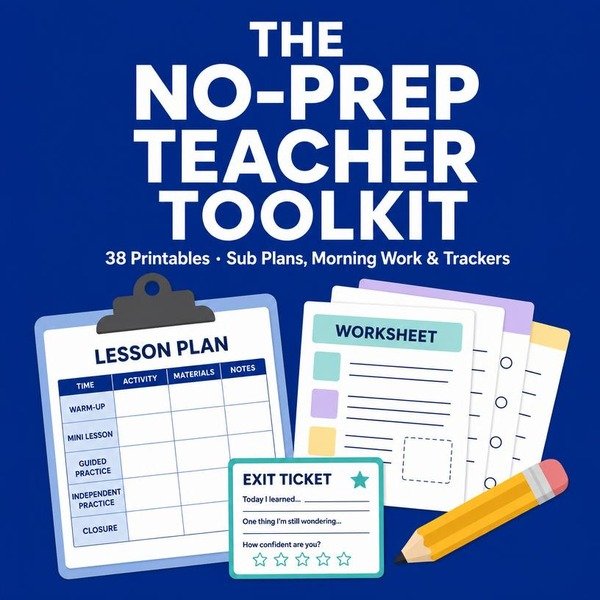
The No-Prep Teacher Toolkit: 38 Printables to Reclaim Your Planning Time


The No-Prep Teacher Toolkit: 38 Printables to Reclaim Your Planning Time — VicLearn


Download the full pack (PDF, A4)Every sheet, print-ready. Save it to your computer — the link never expires.⬇ Download PDF
VicLearnThe No-Prep Teacher Toolkit: 38 Printables to Reclaim Your Planning Time

The No-Prep Teacher Toolkit: 38 Printables to Reclaim Your Planning Time

A streamlined system for classroom management, documentation, and student engagement

37 printable pages

A VicLearn studio pack · 2026 edition · Printed at home, made to last

You will eliminate hours of weekly administrative work by implementing these ready-to-print templates into your daily classroom workflow.

Before you start

How to use this pack

  1. 01Print

    A4 or US Letter, “Fit to page”, black & white is enough. Every sheet is designed low-ink — no full-bleed colour, no wasted toner.

  2. 02Reuse

    Slip a sheet into a plastic sleeve or laminate it and use a dry-erase marker. One page becomes a hundred repetitions.

  3. 03Rotate

    Pick two or three sheets a week, not twenty. Consistency beats volume — 10 to 15 minutes a day is the whole method.

  4. 04Keep

    Punch and file finished pages in a ring binder. By the end you have a portfolio that shows real progress.

Your licence. 37 printable pages for personal or single-classroom use. Print as many copies as you need for your own children or your own students. Please don’t resell, share the file, or upload it to a shared drive — VicLearn is a small studio and every purchase pays for the next pack.

Start here

Your 4-week plan

Each chapter ends with a task box. Do the task the same day you read the chapter, print the matching worksheets from the bonus annex, and tick the box. Four weeks is all it takes to run the whole pack.

When Chapters Workload
Week 1 The Zero-Stress Emergency Sub Folder; Automating Your Morning Routine; Data-Driven Decisions in 30 Seconds 6 worksheets · 10–15 min/day
Week 2 The 10-Minute Weekly Planning Sprint; Managing Small Groups Without the Chaos; Evidence-Based Progress Monitoring 6 worksheets · 10–15 min/day
Week 3 Professionalizing Parent Interactions; Systematizing Student Behavior Records; Building a Culture of Recognition 6 worksheets · 10–15 min/day
Week 4 The End-of-Year Bridge Program 2 worksheets · 10–15 min/day
Chapter 01

The Zero-Stress Emergency Sub Folder

Most teachers build emergency plans by writing custom packets for every absence. You spend three hours on a Sunday night detailing specific page numbers and lesson goals. The sub ignores them, the kids lose the papers, and you return to a mess.

The mistake is assuming the sub needs a narrative. They need a system. Stop writing lessons. Start building a permanent, evergreen activity bank that functions regardless of where your curriculum calendar sits.

Standardize your folder into four 45-minute blocks. The sub follows the block, not the date. If you are out, you simply email the office one line: “Use Folder A.”

Block Grade Level Duration Mastery Criteria
Math Review K-3 45 min 15 correct equations/problems
Reading Fluency K-3 45 min 3 read-aloud repetitions per partner
Silent Writing K-3 45 min 1 page of coherent narrative
Logic/Art K-3 45 min 1 finished visual design task

Print 30 copies of the “Evergreen Worksheet” for each block and keep them in a labeled hanging file. Do not change these papers. Ever. The sub hands them out, sets the timer, and collects them. The content covers foundational skills like place value, high-frequency sight words, and journal prompts that work in September or June.

What to watch for

  • The “I’m Done” Syndrome: Students finish early and disrupt others. Fix this by printing a “When Finished” menu on the back of every page listing 5 specific non-academic tasks, such as organizing their desk or reading a library book.
  • Missing Materials: Subs cannot find your glue sticks or specific math manipulatives. Fix this by placing all necessary tools—pencils, erasers, and the worksheets—inside the physical folder. Do not rely on classroom supplies.
  • Vague Expectations: Children act out when they do not know the sub’s authority. Fix this by including a “Behavior Contract” page in the folder. Students must sign it before receiving the worksheet. It lists 3 rules: stay in your seat, work silently, and raise your hand for help.

Make it yours

Differentiate by Tier: Print the Math Review pages on two different colored papers. White paper is for grade-level expectations; yellow paper is for students needing scaffolded support (e.g., number lines included on the page). Instruct the sub to distribute based on your provided class roster.

Small Group Rotation: If your room has a dedicated aide, adapt the blocks into a rotation. The sub manages the 45-minute independent block while the aide pulls 3 students at a time for 15-minute intervention windows. Use the same evergreen worksheets for the intervention group to ensure the sub stays focused on the remaining 20 students.

Do this tomorrow · 15 minutes

Create a One-Day Emergency Sub Packet — Eliminates morning panic when you are unexpectedly absent.

  1. Select 3 evergreen worksheets covering current math and literacy skills.
  2. Include 1 page of essential class rosters and seating charts.
  3. Place all items into 1 labeled manila folder on your desk.

☐ Done · you know it worked when: The substitute follows the clear instructions and keeps the class on track.

Chapter 02

Automating Your Morning Routine

Most first-grade teachers waste the first 15 minutes of the day managing entry logistics. You are likely spending your morning fielding questions about lunch counts, sharpening pencils, and fixing misplaced folders while the class waits for instructions.

The mistake is assuming morning work must be a “fun” creative activity or a brand-new concept. This requires your constant input to explain directions. By the time you finish your morning administrative duties, 20 minutes of instructional time have vanished.

Shift to a high-repetition, low-stakes spiral review. Students should recognize the format instantly. They walk in, pick up the sheet, and start. No instructions required.

Skill Grade Level Minutes Mastery Criteria
CVC Decoding 1st 5 90% accuracy without sounding out
Number Bonds 1st 3 Under 30 seconds for 5 problems
High-Frequency Words 1st 2 Instant recognition in isolation

Use this four-step sequence to train student independence:

  1. The Anchor Week: Spend the first five days of the unit modeling the exact page layout. Do not grade these. Focus solely on the routine of sitting down and starting.
  2. The 80% Rule: Every page must consist of 80% familiar tasks and 20% new application. If they cannot do most of the page alone, you have failed the automation test.
  3. The Self-Check Station: Place an answer key on a clipboard near the door. Once a student finishes, they check their own work with a red pen. This provides immediate feedback and removes you from the grading loop.
  4. The Monday Reset: Print the week’s five-page packet on Friday. Staple them together. Students keep them in their desks. No daily handing out of papers required.

What to watch for

  • The “I’m Stuck” Loop: Students will approach you for help. Redirect them to the “Ask Three Before Me” rule or the anchor chart. If they are truly stuck, they skip the problem and move to the next one. Do not solve it for them.
  • Pencil Fatigue: If students spend the first 5 minutes hunting for a pencil, the routine fails. Keep a communal sharpener or a bin of sharpened pencils at the entry point.
  • The Perfectionist Stall: Some students will erase until the paper tears. Set a timer for 10 minutes. When the timer sounds, the work stops, regardless of completion. This trains them to maintain a steady pace.

Make it yours

For Kindergarten: Reduce the text density. Use icons to represent the task. Replace the self-check station with a peer-check system where students compare their answers with a partner before turning it in.

For Small Groups: Use the spiral review as a warm-up during your guided reading block. Have the students complete one row on the sheet while you are transitioning the previous group out. This keeps the “at-seat” students occupied for the 3 minutes you need to reset your materials.

Do this tomorrow · 15 minutes

Set Up Three Daily Morning Bins — Prevents chaotic arrivals by giving students immediate, focused tasks.

  1. Gather 3 bins with simple manipulatives like blocks or pattern cards.
  2. Place 1 bin at every table group before you leave today.
  3. Set a 5-minute timer for students to transition to morning work.

☐ Done · you know it worked when: Students enter the room and immediately begin working independently.

Chapter 03

Data-Driven Decisions in 30 Seconds

Most teachers treat exit tickets like a grading chore. You collect thirty scraps of paper, mark them with a check, and file them in a drawer. This is a waste of your time and your students’ potential.

The mistake is viewing the ticket as an assessment of the past. It is not a record of what happened today; it is a blueprint for tomorrow’s instruction. If you spend more than 30 seconds per student reviewing these, you are doing it wrong.

Use this sorting method to instantly divide your class into three distinct groups for the following morning. Keep your feedback limited to a binary indicator: “Got it” or “Needs support.”

Skill Grade Level Time Allotted Mastery Indicator
Double-digit addition 2nd Grade 3 Minutes Correct sum and regrouping
CVC word blending K-1 2 Minutes Correct sound sequence
Main idea identification 3rd Grade 4 Minutes One clear, supporting sentence
  1. The Sort: As students hand you their paper, place it into one of three physical bins: “Ready for Extension,” “Ready for Practice,” or “Needs Small Group Intervention.” Do this in real-time as they exit.
  2. The Plan: Spend exactly 5 minutes before the bell rings to identify the intervention group. If more than 8 students land in the “Needs” bin, your whole-group lesson tomorrow must start with a 10-minute re-teach.
  3. The Execution: During the next day’s independent work block, pull the “Needs” group first. Use the exit ticket as the anchor for the lesson. They see their own work immediately, which builds trust and accountability.

What to watch for

  • The “Copycat” Error: Children often look at their neighbor’s paper during the final minute. Correct this by assigning two different versions of the same problem (A/B format) on the same half-sheet.
  • The “I Tried” Trap: A student writes an answer but leaves the work blank. Treat this as a “Needs Intervention” result. Mastery requires process, not just a lucky guess.
  • The “Too Much Text” Error: If your ticket takes longer than 4 minutes to complete, you are testing stamina, not skill. Keep the prompt to one, high-leverage question.

Make it yours

For K-1 Learners: Use a “Thumb Scale” system. Instead of paper, have students place a sticker on a chart labeled “Easy,” “Okay,” or “Hard.” It takes 30 seconds and provides instant visual data for your small group seating chart.

For 2nd-3rd Grade Groups: Use the “One Question, One Correction” model. If they miss the exit ticket, they must write one sentence explaining *why* they missed it. This forces metacognition and requires them to own their learning path during your small group time.

Do this tomorrow · 15 minutes

Implement a Sticky Note Exit Ticket — Provides immediate feedback on student understanding without grading papers.

  1. Write 1 specific check-for-understanding question on the whiteboard.
  2. Have students write their answer on 1 sticky note.
  3. Collect notes in 2 minutes to sort into ‘got it’ and ‘needs help’ piles.

☐ Done · you know it worked when: Students demonstrate their learning level before leaving the classroom.

Chapter 04

The 10-Minute Weekly Planning Sprint

Most teachers waste hours scripting lessons that never survive first-period contact. You are writing paragraphs of instructional steps for an audience of one: an administrator who rarely reads them. This is the primary mistake of the modern classroom. You are choosing compliance over clarity.

The second mistake is treating your planner like a journal. You do not need to document the “why” or the “philosophy” of every task. You need a high-level checklist that ensures you cover your state standards without requiring a three-page document for a simple math warm-up. Shift your focus from prose to logistics.

Use this 10-minute planning matrix to map your entire week. Print one copy per subject or use one sheet for your daily block. If it doesn’t fit on this single side, it is too complex for a 30-minute instruction window.

Skill Grade Level Minutes Mastery Indicator
Phonics Fluency K-1 10 90% accuracy on sound-symbol mapping.
Number Sense 2 15 Completion of 20 problems in under 3 minutes.
Paragraph Drafting 3 20 Presence of 1 topic sentence and 3 supporting details.
  1. The 2-Minute Scan: Open your district pacing guide. Highlight only the three core standards you must hit this week. Ignore the fluff.
  2. The 5-Minute Mapping: Slot those three standards into your weekly grid. Assign exactly one primary activity to each. If you cannot describe the activity in one sentence, simplify it.
  3. The 3-Minute Resource Check: List the specific page count for student handouts. If you are using a workbook, note the page numbers. If you need a physical manipulative, list the quantity per group.

What to watch for

  • Over-planning: Students rarely finish the “extension” activity you squeezed in. If you find yourself consistently cutting the final 10 minutes, remove the extension from the plan entirely.
  • Vague Objectives: Writing “Practice Math” is useless. Change it to “Solve 10 two-digit addition problems with regrouping.” Specificity prevents decision fatigue on Monday morning.
  • Resource Hoarding: You print 30 copies of a “just in case” worksheet. Stop. If it isn’t on the 10-minute plan, do not print it. You save 45 minutes of prep time per week by eliminating unnecessary copying.

Make it yours

For small groups, add a “Needs” column to your spreadsheet. List the 5 students who require intervention and the 1 specific manipulative they need to grasp the concept. This keeps your group session focused on data rather than searching for materials.

If you are planning for Kindergarten, replace the “Skill” column with “Station Rotation.” Use the 10-minute sprint to assign specific children to specific tables. This eliminates transition chaos before it starts.

Do this tomorrow · 15 minutes

Execute a 10-Minute Weekly Planning Sprint — Stops weekend work by forcing focus on high-impact tasks.

  1. Set a timer for 10 minutes to map out the week.
  2. Identify 3 ‘must-do’ lessons for the upcoming five days.
  3. Draft the 1 main objective for each subject area on a single sheet.

☐ Done · you know it worked when: The teacher feels prepared for the week without working on Sunday.

Chapter 05

Managing Small Groups Without the Chaos

Most teachers create beautiful, complex rotation charts that only they can understand. You spend 20 minutes laminating a masterpiece, but students still swarm your small group table every 5 minutes to ask where they belong. The mistake is assuming children can process abstract time management when they are already cognitively taxed by independent work.

The second error is relying on a static display that doesn’t track progress. If a child cannot see exactly which task is finished and which remains, they default to “I’m done” after 3 minutes of effort. Stop explaining the rotation verbally. Use the visual anchor method below to offload the mental burden of transitions.

Skill Grade Level Time Allotment Mastery Indicator
Transition Autonomy K-1 15 minutes per rotation Zero verbal questions during independent time.
Task Sequencing 2-3 20 minutes per rotation Students self-correct when they notice a skipped step.

Use a “Next-Step” board. Place a physical card for each station (e.g., Word Work, Reading, Writing). Below each station name, list 3 numbered steps. Use icons, not just text. For example, “1. Pick book, 2. Read, 3. Log title.” Tape this chart at eye level. If a student asks what to do, point to the board. Do not answer verbally. After 3 repetitions of this redirection, the student learns to scan the board first.

What to watch for

  • The “I’m Finished” Bluff: If a student claims they are done early, point to the board. Ask them to touch step 2. If they haven’t done it, send them back. Do not engage in a debate about the quality of the work until the rotation is over.
  • Bottlenecking: If students crowd one station, you have too many bodies assigned to one space. Limit stations to 4 students maximum. Use physical chair markers or floor tape to define the boundaries of the station.
  • Transition Drift: If transitions take longer than 90 seconds, you are allowing too much “social chatter” time. Use a 60-second visual timer. When the timer hits zero, the next station starts, regardless of who is seated.

Make it yours

For Kindergarten, replace text with color-coded photo cards. Print a photo of the actual bin or folder used for that station. If the station is “Word Work,” show a photo of the blue bin. This eliminates the “I don’t know where the materials are” excuse.

For Grade 3, use a “Must-Do/May-Do” checklist. Keep the station rotation, but add a “May-Do” list at the bottom of the chart. If they finish the 3 core steps early, they must choose one “May-Do” activity (e.g., silent reading, vocabulary challenge) rather than wandering the room.

For the small group table, keep a “Parking Lot” chart. If a student has a question about the task but you are mid-lesson with a group, they write their name on a sticky note and place it in the “Parking Lot” area. Address these notes only when your small group rotation ends.

Do this tomorrow · 15 minutes

Post a Visual Small Group Rotation Chart — Reduces transition interruptions during guided reading or math groups.

  1. Write 3 group names and 3 activity stations on a poster.
  2. Assign 5 students to each group based on current skill levels.
  3. Display the chart in a visible spot for all to see.

☐ Done · you know it worked when: Students move to their next station silently using the visual guide.

Chapter 06

Evidence-Based Progress Monitoring

Most teachers drown in data binders. You spend hours highlighting spreadsheets that never see the light of day during a conference. Parents leave those meetings confused because they cannot parse 40 pages of raw test scores.

The mistake is hoarding artifacts instead of tracking trends. A parent does not need to see every worksheet from October. They need a single-page snapshot that proves the trajectory of their child’s learning. If you cannot explain a student’s progress in 30 seconds, your tracking system is too complex.

Skill Grade Level Minutes Mastery Definition
Phonemic Segmenting K-1 2 5 words correct in 30 seconds
Fluency Checks 2-3 3 90+ WPM with 95% accuracy
Multiplication Facts 3 2 15 problems correct in 60 seconds

Use the Weekly Growth Snapshot printable included in this toolkit. It features a 5-point scale on the left and a 4-week trend line on the right. Every Friday, spend 90 minutes total for your entire class. Pull students individually for 2 minutes. Plot the raw score. Connect the dots. You now have a visual graph that shows growth, plateaus, or regression.

When a parent asks, “How is he doing?” you hand them the single sheet. The line going upward is your evidence. The line staying flat is your intervention plan. No binders, no fluff, no confusion.

What to watch for

  • The “Good Day” Bias: Students often spike on a single assessment due to guessing. If a score jumps 30% without consistent practice, mark it as an outlier and re-test on Tuesday.
  • Recording Anxiety: Children freeze when they see a stopwatch. Keep the timer hidden. Use a standard digital timer app and set it to silent mode so the student focuses on the task, not the countdown.
  • Inconsistent Prompts: Teachers often change their phrasing during monitoring. Use the exact same prompt every single time. If you say “Tell me the sounds” on week one, do not switch to “Segment these words” on week two.

Make it yours

For Small Groups: Use the “Peer-Check” method for 10 minutes. Pair a high-performing student with a peer. Provide them with a 10-item answer key. Have them track each other’s progress on a shared class chart. It builds accountability and saves you 30 minutes of individual testing time.

For Different Levels: If you are working with K-1 students who struggle with graph lines, replace the data points with color-coded stickers. Green represents mastery, yellow represents nearing, and red represents intervention needed. It provides a non-threatening visual for the student to track their own goals.

For Advanced Learners: Have the student plot their own data. Give them the raw numbers and have them fill in the graph. This shifts the ownership of the growth from you to them, which is the ultimate goal of evidence-based monitoring.

Do this tomorrow · 15 minutes

Launch a Simple Student Data Tracker — Keeps track of student progress without overwhelming paperwork.

  1. Create 1 table with student names and 3 skill columns.
  2. Record the scores of 5 students during today’s independent work time.
  3. Highlight 1 area where a student needs additional support.

☐ Done · you know it worked when: The teacher identifies exactly which students need intervention.

Chapter 07

Professionalizing Parent Interactions

Most teachers treat parent communication as a social favor rather than a professional record. You send sporadic emails, use informal messaging apps, or rely on memory. This is your first mistake. It leaves you vulnerable to “he-said, she-said” disputes and forces you to re-live emotional labor every time a parent questions a grade or an incident.

Parents make the inverse mistake. They treat the teacher like a 24/7 concierge. They expect immediate, chatty responses. When you treat communication as a casual conversation, you invite them to treat your time as their property. Standardizing your log shifts the dynamic from “personal chat” to “data-driven update.”

Skill Grade Level Time Commitment Mastery Criteria
Documented Interaction K-3 3 minutes/entry Objective, neutral fact-listing only.
The “24-Hour” Buffer K-3 24 hours/reply Consistent, predictable response time.
Monthly Summary K-3 15 minutes/month Trend identification for student behavior.

Use a single digital spreadsheet. Create columns for Date, Time, Medium (Email/Phone/App), Topic, and Action Taken. Never use emotional adjectives. Do not write “The parent was angry.” Write “Parent expressed frustration regarding the math rubric.” This protects you legally. If a conversation turns hostile, end it immediately. State: “I want to ensure I have all the facts for our discussion. I will review my documentation and follow up with you via email within 24 hours.” This stops the emotional bleed instantly.

What to watch for

  • The “Venting” Loop: Children often blame a peer for their own lack of impulse control. Correct this by documenting the specific redirection given before the incident occurred. Focus the log on the teacher-led intervention, not the child’s excuse.
  • The “He Said” Trap: When a child reports a peer’s behavior, do not log it as fact. Log it as: “Student reported X. I observed Y.” This removes your liability for hearsay.
  • The Frequent Flyer: If a student has more than 5 documented behavioral incidents in a week, shift from “informational logs” to “formal intervention meetings.” Do not keep emailing; call a meeting to force a change in the home-school partnership.

Make it yours

For Small Groups: If you run intensive reading or behavioral intervention groups, create a “Communication Tab” for each student. Before sending a progress update, review the log entries. If you have 3+ entries showing the same skill deficit, attach a copy of the log to the parent update. It provides the evidence needed to suggest external support or extra practice.

For Tiered Communication: Use a color-coding system in your log. Use Green for positive check-ins (1 minute), Yellow for behavioral updates (3 minutes), and Red for formal disciplinary actions (5+ minutes). If your log is mostly Red, you are not communicating enough Green. Aim for a 3:1 ratio of positive to negative contact. This builds the social capital required to navigate the difficult conversations without the parent becoming defensive.

Do this tomorrow · 15 minutes

Start a Digital Parent Communication Log — Creates a professional record of all home-school interactions.

  1. Open 1 spreadsheet to track parent contact dates and topics.
  2. Log the 2 positive phone calls made to families today.
  3. Save the file in an easily accessible folder on your desktop.

☐ Done · you know it worked when: The teacher maintains a clear history of all parent partnerships.

Chapter 08

Systematizing Student Behavior Records

Most teachers treat behavior logs as archives for “gotcha” moments. You spend your planning period documenting every pencil tap, whisper, or forgotten homework assignment. This creates a mountain of noise that buries the actual student needs.

Parents view these logs as defensive checklists. They see an accumulation of negatives, not a roadmap for growth. When you track every minor incident, you lose the ability to see the signal through the static. Stop logging the noise. Start tracking the trends.

Skill Grade Level Time Commitment Mastery Indicator
Pattern Identification K-3 5 minutes daily 3-day cycle without escalation
Data-Driven Intervention K-3 10 minutes weekly Data triggers a 1:1 meeting

Move away from chronological lists. Use a tally system categorized by function: Avoidance, Attention Seeking, or Skill Deficit. If a student triggers an “Avoidance” mark three times before 10:00 AM, you have a pattern, not a series of isolated choices. This allows you to intervene before the afternoon meltdown occurs.

  1. The Tally Rule: Keep a 3-column sticky note on your clipboard. Mark a single tick only when a behavior disrupts instruction or safety. Ignore minor fidgeting.
  2. The 48-Hour Review: Spend 5 minutes every second day looking at the sticky notes. If a student has more than 5 marks in one category, pull them for a 3-minute chat.
  3. The Direct Link: Ask the student, “I noticed you struggle during math independent work. What is one tool that makes that time easier?” Document their answer as the intervention.

What to watch for

  • The “Everyday” Trap: If you document every single behavior, the data becomes useless. You are looking for spikes. If the log is full, you are measuring frustration, not behavior. Narrow your focus to one specific behavior per student for a 5-day window.
  • Labeling the Child: Avoid writing “disruptive” in the log. Use “talks during direct instruction.” One is a judgment; the other is an observable action you can coach.
  • The Omission Bias: Teachers often fail to log “good” days. Note one “Success” entry for every three “Intervention” entries to keep your perspective balanced during parent conferences.

Make it yours

Small Group Adaptation: Use a single sheet for your guided reading table. Assign a number to each student. Mark a 1 for “Off-Task” or a 2 for “Needs Help.” By the end of the 20-minute block, you will see exactly which student needs a change in task pacing without writing a single sentence.

Tiered Complexity: For Grade 3, involve the student. Give them a 2-inch square grid. Have them place a dot in the square when they feel they need a break. Compare their dots to your tallies on Friday. When the dots and tallies align, the student has reached self-regulation mastery.

Do this tomorrow · 15 minutes

Establish a Quick Classroom Behavior Log — Provides objective data for behavioral interventions and conferences.

  1. Create 1 list to record the date, behavior, and intervention used.
  2. Document 1 specific incident observed during class time today.
  3. Keep the log in 1 secure binder for private access.

☐ Done · you know it worked when: The teacher uses factual data to discuss behavior with stakeholders.

Chapter 09

Building a Culture of Recognition

Most teachers attempt to manage student recognition by relying on complex tracking charts or digital badges. This is a mistake. It forces you to spend 20 minutes every Friday cross-referencing behavioral data instead of teaching. You lose the momentum of the achievement by delaying the reward.

Parents fall into the trap of over-rewarding minor, expected behaviors. This creates an entitlement loop where students lose interest in the recognition. Recognition should be a high-value, low-frequency event that signals a specific growth milestone.

Skill Grade Level Time Commitment Mastery Indicator
Academic Stamina K-1 90 seconds/week Completes 3 independent tasks without redirection.
Collaborative Tone 2-3 90 seconds/week Uses 2 specific “I agree” or “I disagree” phrases.

Use the printable certificates included in your toolkit. Print 40 copies of each of the 4 themes at the start of the grading period. Keep them in a file folder on your desk. Do not use a sign-up sheet or a digital tracker. Observe the class during your standard 45-minute workshop block.

  1. Select the recipient: Choose two students who hit a personal best on the skill listed in the table above.
  2. The “Why” statement: Write exactly one sentence on the certificate. Example: “You stayed in your seat for the entire 15-minute rotation today.”
  3. The delivery: Hand the certificate to the student while they are working. Do not make a scene. Do not stop the lesson.
  4. The visual cue: Have the student tape the certificate to the side of their desk or cubby for exactly 3 days.

What to watch for

  • The “Look-at-me” cycle: Students might fish for praise immediately after receiving a certificate. Correct this by saying, “The certificate was for yesterday’s focus. Today, show me your transition speed.”
  • The paper-chaser: Some children view the certificate as a collectible item rather than an acknowledgment of effort. Correct this by rotating the themes so the extrinsic value of the paper decreases.
  • The excluded observer: Students who didn’t receive one might ask, “Why didn’t I get one?” Correct this by pointing to the specific skill on the certificate. Say, “This week was about stamina. Next week we are focusing on desk organization. That is your goal.”

Make it yours

For small groups: Use the certificates as a “Group Goal” anchor. If your guided reading group stays on task for the full 15-minute session, award the certificate to the group. Display it on the guided reading table for the following week.

For advanced learners: Use the “Peer Recognition” variation. Allow a student who has already mastered the skill to fill out a certificate for a classmate. They must write the “Why” statement. You review it for 10 seconds before they deliver it. This builds social awareness and shifts the culture from teacher-centered to peer-supportive.

Do this tomorrow · 15 minutes

Distribute Three Positive Recognition Certificates — Builds a classroom culture focused on effort and growth.

  1. Print 3 blank certificates for positive behavior or academic effort.
  2. Fill in 1 specific reason for the award on each paper.
  3. Present the awards to 3 students during the final 5 minutes.

☐ Done · you know it worked when: Students feel valued and repeat the positive behaviors celebrated.

Chapter 10

The End-of-Year Bridge Program

Most teachers treat summer packets like an extension of the school year. They assign grade-level worksheets that require parent involvement to explain new concepts. This is a mistake. Parents are not teachers, and by June, they are burnt out. When you force parents to act as instructors, the packet ends up in the trash bin before the Fourth of July.

The goal of a bridge program is maintenance, not growth. The work must be low-stakes and fully independent. If a student needs an adult to explain the directions, the packet is too hard. Success depends on selecting tasks that rely on skills already mastered in your classroom.

Skill Grade Level Minutes per Day Mastery Indicator
Fluency Reading 1-2 10 Read 60 words per minute
Math Fact Speed K-1 5 20 additions in 60 seconds
Journaling 2-3 10 5 sentences with correct punctuation
Phonics Sorts K 5 90% accuracy in picture sorts

Keep the volume low. Distribute exactly 20 pages for the entire summer. This allows for one page per weekday for four weeks. Include a “Check-Off” cover sheet. Students get a physical sense of progress when they mark off a square for each page completed. Do not grade these for accuracy. Grade them for completion only when they return in the fall.

What to watch for

  • Over-reliance on word problems: Students often misread the prompt and quit. Stick to computation or open-ended prompts where there is no single “wrong” answer.
  • Inconsistent formatting: If the layout changes every page, the student will ask for help. Keep the structure identical for all 20 pages so the student can build a routine.
  • The “New Concept” Trap: If you include a topic you haven’t taught yet, the student will panic. Only use review material that they can complete with 95% independence.

Make it yours

For Kindergarten Readiness: Replace the reading logs with “Scavenger Hunts.” List 10 items for them to find in their house that start with specific letter sounds. It keeps them moving without requiring a pencil.

For Grade 3 Enrichment: Add a “Curiosity Challenge.” Assign one project-based task per week, such as drawing a map of their neighborhood or tracking the daily temperature. This moves the work from rote memorization to observational science.

For Small Groups: If you have a group of students struggling with retention, staple a “Cheat Sheet” to the front of their packet. This should include a number line for math and a phonics sound chart. It serves as a visual crutch that empowers them to finish the work without calling a parent for support.

Do this tomorrow · 15 minutes

Draft a Simple Summer Learning Packet — Prevents the summer slide with minimal end-of-year stress.

  1. Select 5 math and 5 reading pages for summer review.
  2. Staple the pages into 1 packet for each student.
  3. Store the packets in 1 box to distribute on the last day.

☐ Done · you know it worked when: Students leave with tools to maintain their skills over the break.

Visual index

Every page at a glance

37 A4 sheets, all low-ink and ready to print. Jump to any page — the number under each thumbnail matches the worksheet number printed at the foot of the sheet.

  1. Emergency sub plan — class information Fill this once in September. It saves the day you wake up sick. VicLearn · The No-Prep Teacher Toolkit · one classroom licence Teacher Grade / room Class size Daily schedule starts at Lunch time Recess Specials today Dismissal routine Nearest helpful teacher Office extension Medical / allergy notes Students who need extra support Behaviour plan in place for Fire drill exit route Everything the substitute needs is in the folder behind this page: three no-prep days, ready to hand out.

    01Emergency sub plan — class information

  2. No-prep sub plan — day 1 A full day that works with no preparation and no photocopier queue. VicLearn · The No-Prep Teacher Toolkit · one classroom licence Arrival (10 min) Hand out the morning work page. Silent work while attendance is taken. Literacy (40 min) Read the story aloud. Students complete the reading response page, then partner-read for 10 minutes. Break Follow the school routine on the class information page. Math (40 min) Model two problems on the board, then the practice page. Early finishers do the challenge box. Lunch Line up in table order. Two students carry the lunch box. Writing (30 min) Prompt on the board. Five sentences minimum, then read one aloud to a partner. Quiet time (20 min) Independent reading or the puzzle page. Wrap-up (10 min) Exit ticket, chairs up, note for the teacher below. Note for the teacher (what went well, who needs a word tomorrow):

    02No-prep sub plan — day 1

  3. No-prep sub plan — day 2 A full day that works with no preparation and no photocopier queue. VicLearn · The No-Prep Teacher Toolkit · one classroom licence Arrival (10 min) Hand out the morning work page. Silent work while attendance is taken. Literacy (40 min) Read the story aloud. Students complete the reading response page, then partner-read for 10 minutes. Break Follow the school routine on the class information page. Math (40 min) Model two problems on the board, then the practice page. Early finishers do the challenge box. Lunch Line up in table order. Two students carry the lunch box. Writing (30 min) Prompt on the board. Five sentences minimum, then read one aloud to a partner. Quiet time (20 min) Independent reading or the puzzle page. Wrap-up (10 min) Exit ticket, chairs up, note for the teacher below. Note for the teacher (what went well, who needs a word tomorrow):

    03No-prep sub plan — day 2

  4. No-prep sub plan — day 3 A full day that works with no preparation and no photocopier queue. VicLearn · The No-Prep Teacher Toolkit · one classroom licence Arrival (10 min) Hand out the morning work page. Silent work while attendance is taken. Literacy (40 min) Read the story aloud. Students complete the reading response page, then partner-read for 10 minutes. Break Follow the school routine on the class information page. Math (40 min) Model two problems on the board, then the practice page. Early finishers do the challenge box. Lunch Line up in table order. Two students carry the lunch box. Writing (30 min) Prompt on the board. Five sentences minimum, then read one aloud to a partner. Quiet time (20 min) Independent reading or the puzzle page. Wrap-up (10 min) Exit ticket, chairs up, note for the teacher below. Note for the teacher (what went well, who needs a word tomorrow):

    04No-prep sub plan — day 3

  5. Morning work — grade K Ten minutes, four sections. Students start the moment they sit down. VicLearn · The No-Prep Teacher Toolkit · one classroom licence Name: Date: 1 · Word work — copy each word, then circle the vowels the and see look we 2 · Number work — solve 2 + 3 = 4 + 1 = 5 + 2 = 3 + 3 = 6 + 2 = 1 + 7 = 3 · Sentence — write one sentence using a word from section 1 4 · Today I feel… and one thing I want to learn

    05Morning work — grade K

  6. Morning work — grade 1 Ten minutes, four sections. Students start the moment they sit down. VicLearn · The No-Prep Teacher Toolkit · one classroom licence Name: Date: 1 · Word work — copy each word, then circle the vowels there where some come were 2 · Number work — solve 12 + 7 = 15 + 8 = 14 – 6 = 18 – 9 = 11 + 9 = 20 – 4 = 3 · Sentence — write one sentence using a word from section 1 4 · Today I feel… and one thing I want to learn

    06Morning work — grade 1

  7. Morning work — grade 2 Ten minutes, four sections. Students start the moment they sit down. VicLearn · The No-Prep Teacher Toolkit · one classroom licence Name: Date: 1 · Word work — copy each word, then circle the vowels because friend again before always 2 · Number work — solve 34 + 18 = 52 – 27 = 46 + 25 = 70 – 38 = 63 + 29 = 81 – 47 = 3 · Sentence — write one sentence using a word from section 1 4 · Today I feel… and one thing I want to learn

    07Morning work — grade 2

  8. Morning work — grade 3 Ten minutes, four sections. Students start the moment they sit down. VicLearn · The No-Prep Teacher Toolkit · one classroom licence Name: Date: 1 · Word work — copy each word, then circle the vowels through enough though thought brought 2 · Number work — solve 7 x 8 = 6 x 9 = 124 + 87 = 305 – 148 = 12 x 4 = 56 / 8 = 3 · Sentence — write one sentence using a word from section 1 4 · Today I feel… and one thing I want to learn

    08Morning work — grade 3

  9. Exit tickets — understanding Cut into four. Collect at the door, sort into got-it / not-yet in 60 seconds. VicLearn · The No-Prep Teacher Toolkit · one classroom licence Name: Date: One thing I learned today: One thing I still don’t get: Rate yourself: 1 2 3 4 5 Name: Date: One thing I learned today: One thing I still don’t get: Rate yourself: 1 2 3 4 5 Name: Date: One thing I learned today: One thing I still don’t get: Rate yourself: 1 2 3 4 5 Name: Date: One thing I learned today: One thing I still don’t get: Rate yourself: 1 2 3 4 5

    09Exit tickets — understanding

  10. Exit tickets — math Cut into four. Collect at the door, sort into got-it / not-yet in 60 seconds. VicLearn · The No-Prep Teacher Toolkit · one classroom licence Name: Date: Solve the problem from today: Explain your first step: Rate yourself: 1 2 3 4 5 Name: Date: Solve the problem from today: Explain your first step: Rate yourself: 1 2 3 4 5 Name: Date: Solve the problem from today: Explain your first step: Rate yourself: 1 2 3 4 5 Name: Date: Solve the problem from today: Explain your first step: Rate yourself: 1 2 3 4 5

    10Exit tickets — math

  11. Exit tickets — reading Cut into four. Collect at the door, sort into got-it / not-yet in 60 seconds. VicLearn · The No-Prep Teacher Toolkit · one classroom licence Name: Date: Who is the main character? One word to describe the text: Rate yourself: 1 2 3 4 5 Name: Date: Who is the main character? One word to describe the text: Rate yourself: 1 2 3 4 5 Name: Date: Who is the main character? One word to describe the text: Rate yourself: 1 2 3 4 5 Name: Date: Who is the main character? One word to describe the text: Rate yourself: 1 2 3 4 5

    11Exit tickets — reading

  12. Weekly lesson plan One page, five days, four subjects. Sits under the register. VicLearn · The No-Prep Teacher Toolkit · one classroom licence Day Literacy Math Topic / science Notes Mon Tue Wed Thu Fri This week’s focus skill:

    12Weekly lesson plan template

  13. Small-group rotation planner Four groups, four stations, 15 minutes each. Rotate on the timer. VicLearn · The No-Prep Teacher Toolkit · one classroom licence Group Station 1 — teacher Station 2 — practice Station 3 — game Station 4 — independent Red Blue Green Yellow Students who need the teacher station twice this week:

    13Small-group rotation planner

  14. Class mastery tracker One skill per column. Tick, half-tick or blank — the gaps show the reteach group. VicLearn · The No-Prep Teacher Toolkit · one classroom licence Student skill 1 skill 2 skill 3 skill 4 skill 5 skill 6 skill 7 skill 8

    14Class mastery tracker

  15. Behaviour & incident log Facts, not adjectives. One line per event — it is what protects you later. VicLearn · The No-Prep Teacher Toolkit · one classroom licence Date Student What happened (observable) Action taken Told home

    15Behaviour & incident log

  16. Parent communication log Every call, note and message in one place, ready for the conference. VicLearn · The No-Prep Teacher Toolkit · one classroom licence Date Family How (call/note/email) Reason & outcome Follow up

    16Parent communication log

  17. Positive notes home Four per page. Two a day is enough to change how a family sees school. VicLearn · The No-Prep Teacher Toolkit · one classroom licence Good news from school made someone else’s day easier today. Teacher: Date: Good news from school kept going with something hard. Teacher: Date: Good news from school asked a really good question today. Teacher: Date: Good news from school was a kind friend at break time. Teacher: Date:

    17Positive notes home

  18. Desk name tags Eight per page. Fold along the middle line and it stands up on the desk. VicLearn · The No-Prep Teacher Toolkit · one classroom licence table ____ table ____ table ____ table ____ table ____ table ____ table ____ table ____

    18Desk name tags

  19. Blank word wall cards Six per page. Write the word, draw the picture, staple it up. VicLearn · The No-Prep Teacher Toolkit · one classroom licence

    19Blank word wall cards

  20. THIS CERTIFICATE IS AWARDED TO Star Reader for reading every single day this month WELL DONE Teacher Date VicLearn · The No-Prep Teacher Toolkit

    20Certificate — Star Reader

  21. THIS CERTIFICATE IS AWARDED TO Math Champion for never giving up on a hard problem WELL DONE Teacher Date VicLearn · The No-Prep Teacher Toolkit

    21Certificate — Math Champion

  22. THIS CERTIFICATE IS AWARDED TO Kindness Award for making the classroom a kinder place WELL DONE Teacher Date VicLearn · The No-Prep Teacher Toolkit

    22Certificate — Kindness Award

  23. Summer packet — week 1 Reading + number bonds. Twenty minutes a day, five days. Nothing else to prepare. VicLearn · The No-Prep Teacher Toolkit · one classroom licence Monday Read for 15 minutes. Title: ______________________________ Write 2 sentences about what you read: Tuesday Read for 15 minutes. Title: ______________________________ Write 3 sentences about what you read: Wednesday Read for 15 minutes. Title: ______________________________ Write 4 sentences about what you read: Thursday Read for 15 minutes. Title: ______________________________ Write 5 sentences about what you read: Friday Read for 15 minutes. Title: ______________________________ Write 6 sentences about what you read: Grown-up signature at the end of the week:

    23Summer packet — week 1

  24. Summer packet — week 2 Sight words + addition. Twenty minutes a day, five days. Nothing else to prepare. VicLearn · The No-Prep Teacher Toolkit · one classroom licence Monday Read for 15 minutes. Title: ______________________________ Write 2 sentences about what you read: Tuesday Read for 15 minutes. Title: ______________________________ Write 3 sentences about what you read: Wednesday Read for 15 minutes. Title: ______________________________ Write 4 sentences about what you read: Thursday Read for 15 minutes. Title: ______________________________ Write 5 sentences about what you read: Friday Read for 15 minutes. Title: ______________________________ Write 6 sentences about what you read: Grown-up signature at the end of the week:

    24Summer packet — week 2

  25. Summer packet — week 3 Writing + place value. Twenty minutes a day, five days. Nothing else to prepare. VicLearn · The No-Prep Teacher Toolkit · one classroom licence Monday Read for 15 minutes. Title: ______________________________ Write 2 sentences about what you read: Tuesday Read for 15 minutes. Title: ______________________________ Write 3 sentences about what you read: Wednesday Read for 15 minutes. Title: ______________________________ Write 4 sentences about what you read: Thursday Read for 15 minutes. Title: ______________________________ Write 5 sentences about what you read: Friday Read for 15 minutes. Title: ______________________________ Write 6 sentences about what you read: Grown-up signature at the end of the week:

    25Summer packet — week 3

  26. Summer packet — week 4 Phonics + subtraction. Twenty minutes a day, five days. Nothing else to prepare. VicLearn · The No-Prep Teacher Toolkit · one classroom licence Monday Read for 15 minutes. Title: ______________________________ Write 2 sentences about what you read: Tuesday Read for 15 minutes. Title: ______________________________ Write 3 sentences about what you read: Wednesday Read for 15 minutes. Title: ______________________________ Write 4 sentences about what you read: Thursday Read for 15 minutes. Title: ______________________________ Write 5 sentences about what you read: Friday Read for 15 minutes. Title: ______________________________ Write 6 sentences about what you read: Grown-up signature at the end of the week:

    26Summer packet — week 4

  27. Summer packet — week 5 Fluency + skip counting. Twenty minutes a day, five days. Nothing else to prepare. VicLearn · The No-Prep Teacher Toolkit · one classroom licence Monday Read for 15 minutes. Title: ______________________________ Write 2 sentences about what you read: Tuesday Read for 15 minutes. Title: ______________________________ Write 3 sentences about what you read: Wednesday Read for 15 minutes. Title: ______________________________ Write 4 sentences about what you read: Thursday Read for 15 minutes. Title: ______________________________ Write 5 sentences about what you read: Friday Read for 15 minutes. Title: ______________________________ Write 6 sentences about what you read: Grown-up signature at the end of the week:

    27Summer packet — week 5

  28. Summer packet — week 6 Story retell + time. Twenty minutes a day, five days. Nothing else to prepare. VicLearn · The No-Prep Teacher Toolkit · one classroom licence Monday Read for 15 minutes. Title: ______________________________ Write 2 sentences about what you read: Tuesday Read for 15 minutes. Title: ______________________________ Write 3 sentences about what you read: Wednesday Read for 15 minutes. Title: ______________________________ Write 4 sentences about what you read: Thursday Read for 15 minutes. Title: ______________________________ Write 5 sentences about what you read: Friday Read for 15 minutes. Title: ______________________________ Write 6 sentences about what you read: Grown-up signature at the end of the week:

    28Summer packet — week 6

  29. Summer packet — week 7 Vocabulary + regrouping. Twenty minutes a day, five days. Nothing else to prepare. VicLearn · The No-Prep Teacher Toolkit · one classroom licence Monday Read for 15 minutes. Title: ______________________________ Write 2 sentences about what you read: Tuesday Read for 15 minutes. Title: ______________________________ Write 3 sentences about what you read: Wednesday Read for 15 minutes. Title: ______________________________ Write 4 sentences about what you read: Thursday Read for 15 minutes. Title: ______________________________ Write 5 sentences about what you read: Friday Read for 15 minutes. Title: ______________________________ Write 6 sentences about what you read: Grown-up signature at the end of the week:

    29Summer packet — week 7

  30. Summer packet — week 8 Review week. Twenty minutes a day, five days. Nothing else to prepare. VicLearn · The No-Prep Teacher Toolkit · one classroom licence Monday Read for 15 minutes. Title: ______________________________ Write 2 sentences about what you read: Tuesday Read for 15 minutes. Title: ______________________________ Write 3 sentences about what you read: Wednesday Read for 15 minutes. Title: ______________________________ Write 4 sentences about what you read: Thursday Read for 15 minutes. Title: ______________________________ Write 5 sentences about what you read: Friday Read for 15 minutes. Title: ______________________________ Write 6 sentences about what you read: Grown-up signature at the end of the week:

    30Summer packet — week 8

  31. Multiplication practice — 6× Fill the grid, then solve the problems VicLearn · viclearn.com · free printable Name: 6 × 1 = 6 × 2 = 6 × 3 = 6 × 4 = 6 × 5 = 6 × 6 = 6 × 7 = 6 × 8 = 6 × 9 = 6 × 10 = Mixed practice 6 × 6 = 9 × 6 = 5 × 6 = 2 × 6 = 1 × 6 = 3 × 6 = 8 × 6 = 4 × 6 = 7 × 6 = 3 × 6 = 7 × 6 = 1 × 6 =

    31Multiplication practice — 6×

  32. Multiplication practice — 7× Fill the grid, then solve the problems VicLearn · viclearn.com · free printable Name: 7 × 1 = 7 × 2 = 7 × 3 = 7 × 4 = 7 × 5 = 7 × 6 = 7 × 7 = 7 × 8 = 7 × 9 = 7 × 10 = Mixed practice 1 × 7 = 1 × 7 = 8 × 7 = 10 × 7 = 8 × 7 = 2 × 7 = 5 × 7 = 3 × 7 = 8 × 7 = 1 × 7 = 7 × 7 = 10 × 7 =

    32Multiplication practice — 7×

  33. Multiplication practice — 8× Fill the grid, then solve the problems VicLearn · viclearn.com · free printable Name: 8 × 1 = 8 × 2 = 8 × 3 = 8 × 4 = 8 × 5 = 8 × 6 = 8 × 7 = 8 × 8 = 8 × 9 = 8 × 10 = Mixed practice 7 × 8 = 6 × 8 = 5 × 8 = 1 × 8 = 6 × 8 = 5 × 8 = 3 × 8 = 8 × 8 = 6 × 8 = 1 × 8 = 6 × 8 = 4 × 8 =

    33Multiplication practice — 8×

  34. Addition & subtraction (0–20) Solve each problem and check your answers VicLearn · viclearn.com · free printable Name: 2 + 5 = 14 − 14 = 2 + 16 = 14 − 10 = 7 + 10 = 17 − 3 = 1 + 17 = 13 − 1 = 6 + 7 = 17 − 11 = 14 + 1 = 20 − 14 = 10 + 16 = 19 − 8 = 3 + 15 = 20 − 15 = 16 + 12 = 16 − 5 = 12 + 16 = 17 − 8 = 8 + 14 = 20 − 10 = 2 + 5 = 13 − 8 =

    34Addition & subtraction (0–20)

  35. Memory cards Cut along the dotted lines and match the pairs VicLearn · viclearn.com · free printable Cat Fish Flower Butterfly Star House Tree Rocket Ice cream Owl Turtle Balloon Dog Dragon Unicorn Horse Dinosaur Bird Sun Heart Rose Panda Shark Penguin Elephant Lion Bee Frog Snowman Car Cupcake Dolphin

    35Memory cards

  36. Memory cards Cut along the dotted lines and match the pairs VicLearn · viclearn.com · free printable Cat Fish Flower Butterfly Star House Tree Rocket Ice cream Owl Turtle Balloon Dog Dragon Unicorn Horse Dinosaur Bird Sun Heart Rose Panda Shark Penguin Elephant Lion Bee Frog Snowman Car Cupcake Dolphin

    36Memory cards

  37. Help the pencil find the way Start at the arrow and reach the star VicLearn · viclearn.com · free printable Name:

    37Help the pencil find the way (3)

The pack

37 print-ready worksheets

Print the whole annex, or a single page from your browser (Ctrl/Cmd + P, then the page number in the caption).

The folder you leave for the substitute

Class information plus three full no-prep days. Fill it once in September.

Worksheet 01 · Emergency sub plan — class information
Emergency sub plan — class information Fill this once in September. It saves the day you wake up sick. VicLearn · The No-Prep Teacher Toolkit · one classroom licence Teacher Grade / room Class size Daily schedule starts at Lunch time Recess Specials today Dismissal routine Nearest helpful teacher Office extension Medical / allergy notes Students who need extra support Behaviour plan in place for Fire drill exit route Everything the substitute needs is in the folder behind this page: three no-prep days, ready to hand out.
Emergency sub plan — class informationVicLearn · Worksheet 01
Worksheet 02 · No-prep sub plan — day 1
No-prep sub plan — day 1 A full day that works with no preparation and no photocopier queue. VicLearn · The No-Prep Teacher Toolkit · one classroom licence Arrival (10 min) Hand out the morning work page. Silent work while attendance is taken. Literacy (40 min) Read the story aloud. Students complete the reading response page, then partner-read for 10 minutes. Break Follow the school routine on the class information page. Math (40 min) Model two problems on the board, then the practice page. Early finishers do the challenge box. Lunch Line up in table order. Two students carry the lunch box. Writing (30 min) Prompt on the board. Five sentences minimum, then read one aloud to a partner. Quiet time (20 min) Independent reading or the puzzle page. Wrap-up (10 min) Exit ticket, chairs up, note for the teacher below. Note for the teacher (what went well, who needs a word tomorrow):
No-prep sub plan — day 1VicLearn · Worksheet 02
Worksheet 03 · No-prep sub plan — day 2
No-prep sub plan — day 2 A full day that works with no preparation and no photocopier queue. VicLearn · The No-Prep Teacher Toolkit · one classroom licence Arrival (10 min) Hand out the morning work page. Silent work while attendance is taken. Literacy (40 min) Read the story aloud. Students complete the reading response page, then partner-read for 10 minutes. Break Follow the school routine on the class information page. Math (40 min) Model two problems on the board, then the practice page. Early finishers do the challenge box. Lunch Line up in table order. Two students carry the lunch box. Writing (30 min) Prompt on the board. Five sentences minimum, then read one aloud to a partner. Quiet time (20 min) Independent reading or the puzzle page. Wrap-up (10 min) Exit ticket, chairs up, note for the teacher below. Note for the teacher (what went well, who needs a word tomorrow):
No-prep sub plan — day 2VicLearn · Worksheet 03
Worksheet 04 · No-prep sub plan — day 3
No-prep sub plan — day 3 A full day that works with no preparation and no photocopier queue. VicLearn · The No-Prep Teacher Toolkit · one classroom licence Arrival (10 min) Hand out the morning work page. Silent work while attendance is taken. Literacy (40 min) Read the story aloud. Students complete the reading response page, then partner-read for 10 minutes. Break Follow the school routine on the class information page. Math (40 min) Model two problems on the board, then the practice page. Early finishers do the challenge box. Lunch Line up in table order. Two students carry the lunch box. Writing (30 min) Prompt on the board. Five sentences minimum, then read one aloud to a partner. Quiet time (20 min) Independent reading or the puzzle page. Wrap-up (10 min) Exit ticket, chairs up, note for the teacher below. Note for the teacher (what went well, who needs a word tomorrow):
No-prep sub plan — day 3VicLearn · Worksheet 04

Morning work, K to grade 3

Ten silent minutes while you take the register — word work, number work, a sentence.

Worksheet 05 · Morning work — grade K
Morning work — grade K Ten minutes, four sections. Students start the moment they sit down. VicLearn · The No-Prep Teacher Toolkit · one classroom licence Name: Date: 1 · Word work — copy each word, then circle the vowels the and see look we 2 · Number work — solve 2 + 3 = 4 + 1 = 5 + 2 = 3 + 3 = 6 + 2 = 1 + 7 = 3 · Sentence — write one sentence using a word from section 1 4 · Today I feel… and one thing I want to learn
Morning work — grade KVicLearn · Worksheet 05
Worksheet 06 · Morning work — grade 1
Morning work — grade 1 Ten minutes, four sections. Students start the moment they sit down. VicLearn · The No-Prep Teacher Toolkit · one classroom licence Name: Date: 1 · Word work — copy each word, then circle the vowels there where some come were 2 · Number work — solve 12 + 7 = 15 + 8 = 14 – 6 = 18 – 9 = 11 + 9 = 20 – 4 = 3 · Sentence — write one sentence using a word from section 1 4 · Today I feel… and one thing I want to learn
Morning work — grade 1VicLearn · Worksheet 06
Worksheet 07 · Morning work — grade 2
Morning work — grade 2 Ten minutes, four sections. Students start the moment they sit down. VicLearn · The No-Prep Teacher Toolkit · one classroom licence Name: Date: 1 · Word work — copy each word, then circle the vowels because friend again before always 2 · Number work — solve 34 + 18 = 52 – 27 = 46 + 25 = 70 – 38 = 63 + 29 = 81 – 47 = 3 · Sentence — write one sentence using a word from section 1 4 · Today I feel… and one thing I want to learn
Morning work — grade 2VicLearn · Worksheet 07
Worksheet 08 · Morning work — grade 3
Morning work — grade 3 Ten minutes, four sections. Students start the moment they sit down. VicLearn · The No-Prep Teacher Toolkit · one classroom licence Name: Date: 1 · Word work — copy each word, then circle the vowels through enough though thought brought 2 · Number work — solve 7 x 8 = 6 x 9 = 124 + 87 = 305 – 148 = 12 x 4 = 56 / 8 = 3 · Sentence — write one sentence using a word from section 1 4 · Today I feel… and one thing I want to learn
Morning work — grade 3VicLearn · Worksheet 08

Exit tickets

Four per page. Sort got-it / not-yet at the door in under a minute.

Worksheet 09 · Exit tickets — understanding
Exit tickets — understanding Cut into four. Collect at the door, sort into got-it / not-yet in 60 seconds. VicLearn · The No-Prep Teacher Toolkit · one classroom licence Name: Date: One thing I learned today: One thing I still don’t get: Rate yourself: 1 2 3 4 5 Name: Date: One thing I learned today: One thing I still don’t get: Rate yourself: 1 2 3 4 5 Name: Date: One thing I learned today: One thing I still don’t get: Rate yourself: 1 2 3 4 5 Name: Date: One thing I learned today: One thing I still don’t get: Rate yourself: 1 2 3 4 5
Exit tickets — understandingVicLearn · Worksheet 09
Worksheet 10 · Exit tickets — math
Exit tickets — math Cut into four. Collect at the door, sort into got-it / not-yet in 60 seconds. VicLearn · The No-Prep Teacher Toolkit · one classroom licence Name: Date: Solve the problem from today: Explain your first step: Rate yourself: 1 2 3 4 5 Name: Date: Solve the problem from today: Explain your first step: Rate yourself: 1 2 3 4 5 Name: Date: Solve the problem from today: Explain your first step: Rate yourself: 1 2 3 4 5 Name: Date: Solve the problem from today: Explain your first step: Rate yourself: 1 2 3 4 5
Exit tickets — mathVicLearn · Worksheet 10
Worksheet 11 · Exit tickets — reading
Exit tickets — reading Cut into four. Collect at the door, sort into got-it / not-yet in 60 seconds. VicLearn · The No-Prep Teacher Toolkit · one classroom licence Name: Date: Who is the main character? One word to describe the text: Rate yourself: 1 2 3 4 5 Name: Date: Who is the main character? One word to describe the text: Rate yourself: 1 2 3 4 5 Name: Date: Who is the main character? One word to describe the text: Rate yourself: 1 2 3 4 5 Name: Date: Who is the main character? One word to describe the text: Rate yourself: 1 2 3 4 5
Exit tickets — readingVicLearn · Worksheet 11

Planning on one page

Weekly plan, small-group rotation and a class mastery grid that shows the reteach group.

Worksheet 12 · Weekly lesson plan template
Weekly lesson plan One page, five days, four subjects. Sits under the register. VicLearn · The No-Prep Teacher Toolkit · one classroom licence Day Literacy Math Topic / science Notes Mon Tue Wed Thu Fri This week’s focus skill:
Weekly lesson plan templateVicLearn · Worksheet 12
Worksheet 13 · Small-group rotation planner
Small-group rotation planner Four groups, four stations, 15 minutes each. Rotate on the timer. VicLearn · The No-Prep Teacher Toolkit · one classroom licence Group Station 1 — teacher Station 2 — practice Station 3 — game Station 4 — independent Red Blue Green Yellow Students who need the teacher station twice this week:
Small-group rotation plannerVicLearn · Worksheet 13

Records and families

Behaviour log written in observable facts, contact log, and good-news notes home.

Worksheet 14 · Class mastery tracker
Class mastery tracker One skill per column. Tick, half-tick or blank — the gaps show the reteach group. VicLearn · The No-Prep Teacher Toolkit · one classroom licence Student skill 1 skill 2 skill 3 skill 4 skill 5 skill 6 skill 7 skill 8
Class mastery trackerVicLearn · Worksheet 14
Worksheet 15 · Behaviour & incident log
Behaviour & incident log Facts, not adjectives. One line per event — it is what protects you later. VicLearn · The No-Prep Teacher Toolkit · one classroom licence Date Student What happened (observable) Action taken Told home
Behaviour & incident logVicLearn · Worksheet 15
Worksheet 16 · Parent communication log
Parent communication log Every call, note and message in one place, ready for the conference. VicLearn · The No-Prep Teacher Toolkit · one classroom licence Date Family How (call/note/email) Reason & outcome Follow up
Parent communication logVicLearn · Worksheet 16
Worksheet 17 · Positive notes home
Positive notes home Four per page. Two a day is enough to change how a family sees school. VicLearn · The No-Prep Teacher Toolkit · one classroom licence Good news from school made someone else’s day easier today. Teacher: Date: Good news from school kept going with something hard. Teacher: Date: Good news from school asked a really good question today. Teacher: Date: Good news from school was a kind friend at break time. Teacher: Date:
Positive notes homeVicLearn · Worksheet 17

Classroom set

Desk name tags, blank word wall cards and three certificates.

Worksheet 18 · Desk name tags
Desk name tags Eight per page. Fold along the middle line and it stands up on the desk. VicLearn · The No-Prep Teacher Toolkit · one classroom licence table ____ table ____ table ____ table ____ table ____ table ____ table ____ table ____
Desk name tagsVicLearn · Worksheet 18
Worksheet 19 · Blank word wall cards
Blank word wall cards Six per page. Write the word, draw the picture, staple it up. VicLearn · The No-Prep Teacher Toolkit · one classroom licence
Blank word wall cardsVicLearn · Worksheet 19
Worksheet 20 · Certificate — Star Reader
THIS CERTIFICATE IS AWARDED TO Star Reader for reading every single day this month WELL DONE Teacher Date VicLearn · The No-Prep Teacher Toolkit
Certificate — Star ReaderVicLearn · Worksheet 20
Worksheet 21 · Certificate — Math Champion
THIS CERTIFICATE IS AWARDED TO Math Champion for never giving up on a hard problem WELL DONE Teacher Date VicLearn · The No-Prep Teacher Toolkit
Certificate — Math ChampionVicLearn · Worksheet 21
Worksheet 22 · Certificate — Kindness Award
THIS CERTIFICATE IS AWARDED TO Kindness Award for making the classroom a kinder place WELL DONE Teacher Date VicLearn · The No-Prep Teacher Toolkit
Certificate — Kindness AwardVicLearn · Worksheet 22

Eight-week summer packet

Twenty minutes a day of reading and writing, ready to send home in June.

Worksheet 23 · Summer packet — week 1
Summer packet — week 1 Reading + number bonds. Twenty minutes a day, five days. Nothing else to prepare. VicLearn · The No-Prep Teacher Toolkit · one classroom licence Monday Read for 15 minutes. Title: ______________________________ Write 2 sentences about what you read: Tuesday Read for 15 minutes. Title: ______________________________ Write 3 sentences about what you read: Wednesday Read for 15 minutes. Title: ______________________________ Write 4 sentences about what you read: Thursday Read for 15 minutes. Title: ______________________________ Write 5 sentences about what you read: Friday Read for 15 minutes. Title: ______________________________ Write 6 sentences about what you read: Grown-up signature at the end of the week:
Summer packet — week 1VicLearn · Worksheet 23
Worksheet 24 · Summer packet — week 2
Summer packet — week 2 Sight words + addition. Twenty minutes a day, five days. Nothing else to prepare. VicLearn · The No-Prep Teacher Toolkit · one classroom licence Monday Read for 15 minutes. Title: ______________________________ Write 2 sentences about what you read: Tuesday Read for 15 minutes. Title: ______________________________ Write 3 sentences about what you read: Wednesday Read for 15 minutes. Title: ______________________________ Write 4 sentences about what you read: Thursday Read for 15 minutes. Title: ______________________________ Write 5 sentences about what you read: Friday Read for 15 minutes. Title: ______________________________ Write 6 sentences about what you read: Grown-up signature at the end of the week:
Summer packet — week 2VicLearn · Worksheet 24
Worksheet 25 · Summer packet — week 3
Summer packet — week 3 Writing + place value. Twenty minutes a day, five days. Nothing else to prepare. VicLearn · The No-Prep Teacher Toolkit · one classroom licence Monday Read for 15 minutes. Title: ______________________________ Write 2 sentences about what you read: Tuesday Read for 15 minutes. Title: ______________________________ Write 3 sentences about what you read: Wednesday Read for 15 minutes. Title: ______________________________ Write 4 sentences about what you read: Thursday Read for 15 minutes. Title: ______________________________ Write 5 sentences about what you read: Friday Read for 15 minutes. Title: ______________________________ Write 6 sentences about what you read: Grown-up signature at the end of the week:
Summer packet — week 3VicLearn · Worksheet 25
Worksheet 26 · Summer packet — week 4
Summer packet — week 4 Phonics + subtraction. Twenty minutes a day, five days. Nothing else to prepare. VicLearn · The No-Prep Teacher Toolkit · one classroom licence Monday Read for 15 minutes. Title: ______________________________ Write 2 sentences about what you read: Tuesday Read for 15 minutes. Title: ______________________________ Write 3 sentences about what you read: Wednesday Read for 15 minutes. Title: ______________________________ Write 4 sentences about what you read: Thursday Read for 15 minutes. Title: ______________________________ Write 5 sentences about what you read: Friday Read for 15 minutes. Title: ______________________________ Write 6 sentences about what you read: Grown-up signature at the end of the week:
Summer packet — week 4VicLearn · Worksheet 26
Worksheet 27 · Summer packet — week 5
Summer packet — week 5 Fluency + skip counting. Twenty minutes a day, five days. Nothing else to prepare. VicLearn · The No-Prep Teacher Toolkit · one classroom licence Monday Read for 15 minutes. Title: ______________________________ Write 2 sentences about what you read: Tuesday Read for 15 minutes. Title: ______________________________ Write 3 sentences about what you read: Wednesday Read for 15 minutes. Title: ______________________________ Write 4 sentences about what you read: Thursday Read for 15 minutes. Title: ______________________________ Write 5 sentences about what you read: Friday Read for 15 minutes. Title: ______________________________ Write 6 sentences about what you read: Grown-up signature at the end of the week:
Summer packet — week 5VicLearn · Worksheet 27
Worksheet 28 · Summer packet — week 6
Summer packet — week 6 Story retell + time. Twenty minutes a day, five days. Nothing else to prepare. VicLearn · The No-Prep Teacher Toolkit · one classroom licence Monday Read for 15 minutes. Title: ______________________________ Write 2 sentences about what you read: Tuesday Read for 15 minutes. Title: ______________________________ Write 3 sentences about what you read: Wednesday Read for 15 minutes. Title: ______________________________ Write 4 sentences about what you read: Thursday Read for 15 minutes. Title: ______________________________ Write 5 sentences about what you read: Friday Read for 15 minutes. Title: ______________________________ Write 6 sentences about what you read: Grown-up signature at the end of the week:
Summer packet — week 6VicLearn · Worksheet 28
Worksheet 29 · Summer packet — week 7
Summer packet — week 7 Vocabulary + regrouping. Twenty minutes a day, five days. Nothing else to prepare. VicLearn · The No-Prep Teacher Toolkit · one classroom licence Monday Read for 15 minutes. Title: ______________________________ Write 2 sentences about what you read: Tuesday Read for 15 minutes. Title: ______________________________ Write 3 sentences about what you read: Wednesday Read for 15 minutes. Title: ______________________________ Write 4 sentences about what you read: Thursday Read for 15 minutes. Title: ______________________________ Write 5 sentences about what you read: Friday Read for 15 minutes. Title: ______________________________ Write 6 sentences about what you read: Grown-up signature at the end of the week:
Summer packet — week 7VicLearn · Worksheet 29
Worksheet 30 · Summer packet — week 8
Summer packet — week 8 Review week. Twenty minutes a day, five days. Nothing else to prepare. VicLearn · The No-Prep Teacher Toolkit · one classroom licence Monday Read for 15 minutes. Title: ______________________________ Write 2 sentences about what you read: Tuesday Read for 15 minutes. Title: ______________________________ Write 3 sentences about what you read: Wednesday Read for 15 minutes. Title: ______________________________ Write 4 sentences about what you read: Thursday Read for 15 minutes. Title: ______________________________ Write 5 sentences about what you read: Friday Read for 15 minutes. Title: ______________________________ Write 6 sentences about what you read: Grown-up signature at the end of the week:
Summer packet — week 8VicLearn · Worksheet 30

Bonus: drill & filler pages

Fast finishers, indoor recess, the last ten minutes of Friday.

Worksheet 31 · Multiplication practice — 6×
Multiplication practice — 6× Fill the grid, then solve the problems VicLearn · viclearn.com · free printable Name: 6 × 1 = 6 × 2 = 6 × 3 = 6 × 4 = 6 × 5 = 6 × 6 = 6 × 7 = 6 × 8 = 6 × 9 = 6 × 10 = Mixed practice 6 × 6 = 9 × 6 = 5 × 6 = 2 × 6 = 1 × 6 = 3 × 6 = 8 × 6 = 4 × 6 = 7 × 6 = 3 × 6 = 7 × 6 = 1 × 6 =
Multiplication practice — 6×VicLearn · Worksheet 31
Worksheet 32 · Multiplication practice — 7×
Multiplication practice — 7× Fill the grid, then solve the problems VicLearn · viclearn.com · free printable Name: 7 × 1 = 7 × 2 = 7 × 3 = 7 × 4 = 7 × 5 = 7 × 6 = 7 × 7 = 7 × 8 = 7 × 9 = 7 × 10 = Mixed practice 1 × 7 = 1 × 7 = 8 × 7 = 10 × 7 = 8 × 7 = 2 × 7 = 5 × 7 = 3 × 7 = 8 × 7 = 1 × 7 = 7 × 7 = 10 × 7 =
Multiplication practice — 7×VicLearn · Worksheet 32
Worksheet 33 · Multiplication practice — 8×
Multiplication practice — 8× Fill the grid, then solve the problems VicLearn · viclearn.com · free printable Name: 8 × 1 = 8 × 2 = 8 × 3 = 8 × 4 = 8 × 5 = 8 × 6 = 8 × 7 = 8 × 8 = 8 × 9 = 8 × 10 = Mixed practice 7 × 8 = 6 × 8 = 5 × 8 = 1 × 8 = 6 × 8 = 5 × 8 = 3 × 8 = 8 × 8 = 6 × 8 = 1 × 8 = 6 × 8 = 4 × 8 =
Multiplication practice — 8×VicLearn · Worksheet 33
Worksheet 34 · Addition & subtraction (0–20)
Addition & subtraction (0–20) Solve each problem and check your answers VicLearn · viclearn.com · free printable Name: 2 + 5 = 14 − 14 = 2 + 16 = 14 − 10 = 7 + 10 = 17 − 3 = 1 + 17 = 13 − 1 = 6 + 7 = 17 − 11 = 14 + 1 = 20 − 14 = 10 + 16 = 19 − 8 = 3 + 15 = 20 − 15 = 16 + 12 = 16 − 5 = 12 + 16 = 17 − 8 = 8 + 14 = 20 − 10 = 2 + 5 = 13 − 8 =
Addition & subtraction (0–20)VicLearn · Worksheet 34
Worksheet 35 · Memory cards
Memory cards Cut along the dotted lines and match the pairs VicLearn · viclearn.com · free printable Cat Fish Flower Butterfly Star House Tree Rocket Ice cream Owl Turtle Balloon Dog Dragon Unicorn Horse Dinosaur Bird Sun Heart Rose Panda Shark Penguin Elephant Lion Bee Frog Snowman Car Cupcake Dolphin
Memory cardsVicLearn · Worksheet 35
Worksheet 36 · Memory cards
Memory cards Cut along the dotted lines and match the pairs VicLearn · viclearn.com · free printable Cat Fish Flower Butterfly Star House Tree Rocket Ice cream Owl Turtle Balloon Dog Dragon Unicorn Horse Dinosaur Bird Sun Heart Rose Panda Shark Penguin Elephant Lion Bee Frog Snowman Car Cupcake Dolphin
Memory cardsVicLearn · Worksheet 36
Worksheet 37 · Help the pencil find the way (3)
Help the pencil find the way Start at the arrow and reach the star VicLearn · viclearn.com · free printable Name:
Help the pencil find the way (3)VicLearn · Worksheet 37
© 2026 VicLearn. Personal or single-classroom use only — please don’t redistribute.
Found a mistake or want a page added? Reply to the email that delivered this pack.


Get the complete pack of this set — free

One email, one link, all the sheets of this topic in a single PDF. No spam, unsubscribe in one click.

What you need to print this well

Links to Amazon. If you buy through them we earn a small commission at no extra cost — it keeps every sheet on this site free.

Want the printer-ready mega packs? See the printable packs.

Índice de Conteúdo