The 25 skills that predict a smooth kindergarten start — and the ones parents worry about that do not. Free printable checklist and tracker.
Type your child’s name and print a custom tracing worksheet in seconds — free, no sign-up.
Make my worksheet →
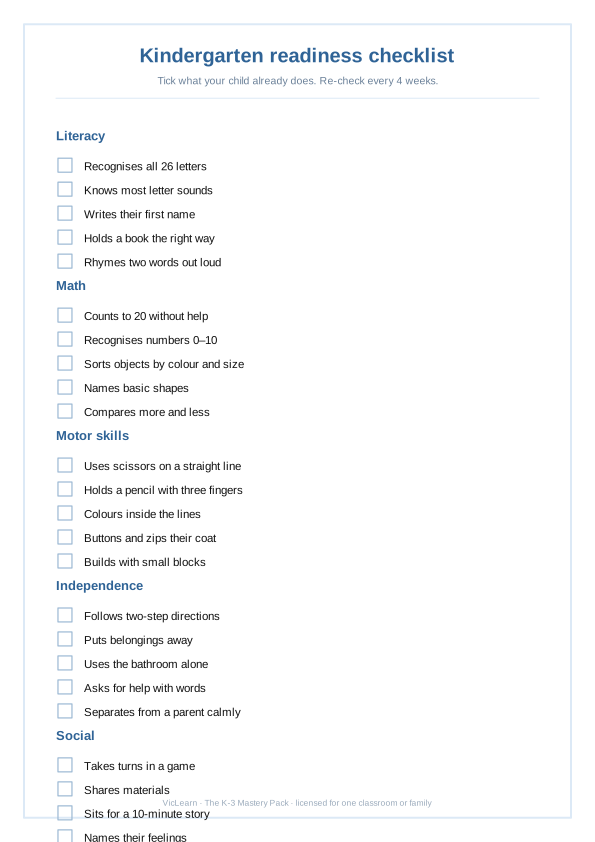
Free kindergarten readiness checklist to download
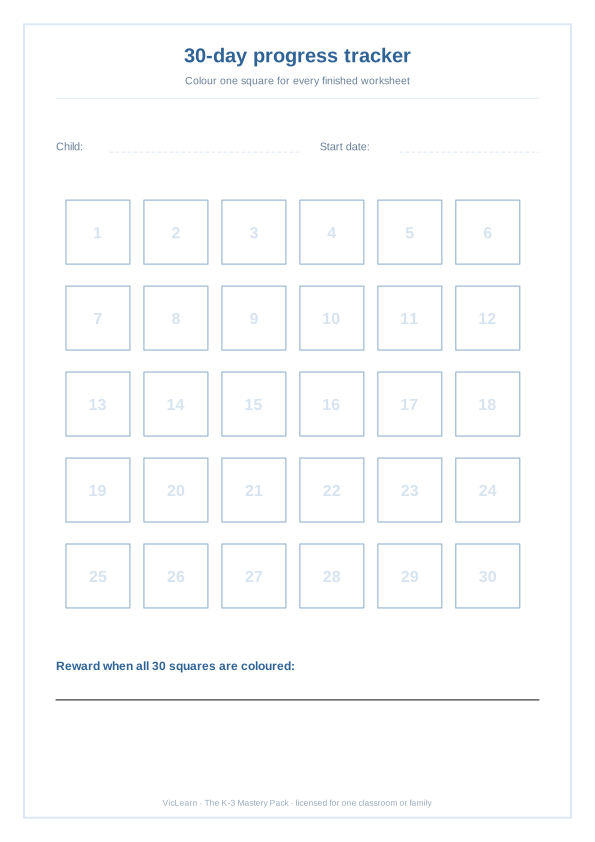
Two ready-to-print A4 sheets, drawn as vectors by VicLearn — no sign-up, no watermark, no redirect to another site.
Independence predicts more than academics
Teachers consistently report that the children who settle fastest are not the ones who can already read. They are the ones who can follow a two-step instruction, ask for help in words, manage the bathroom alone and separate from a parent calmly.
Academic gaps close within a term. Self-regulation gaps take much longer, because they affect every part of the day.
The five areas, and what to look for
| Area | Ready looks like | Practise at home by |
|---|---|---|
| Literacy | Knows most letter sounds, writes their first name, hears rhymes | Reading aloud daily; name in dots to trace |
| Maths | Counts to 20, recognises 0–10, sorts by colour and size | Counting stairs, sorting laundry |
| Motor | Cuts a straight line, tripod pencil grip, buttons a coat | Scissors on junk mail; dressing without help |
| Independence | Two-step directions, tidies up, toilets alone | Giving two instructions at once, on purpose |
| Social | Takes turns, shares, sits for a 10-minute story | Board games with real turn-taking |
What you can safely stop worrying about
- Reading before kindergarten. Not expected and not predictive of later reading level.
- Perfect letter formation. Reversals are developmentally normal until around age 7.
- Writing beyond their own name. Not required anywhere in the standard curriculum.
- Counting past 20. Understanding 1–10 well is worth far more than reciting to 100.
How to use the checklist without turning it into a test
Tick what your child already does today, then re-check every four weeks. Two or three unticked items in an area is a normal profile, not a red flag — pick one to work on and ignore the rest. If most items in a single area stay unticked over three months, that is the point to mention it to the teacher or your paediatrician.
Frequently asked questions
Should my child read before kindergarten?
No. Knowing most letter sounds is helpful; reading words is not expected and confers no measurable long-term advantage.
What is the single most important readiness skill?
Following a two-step instruction without a reminder. It underpins almost everything else a classroom asks for.
My child is not ready. Should we delay a year?
Delaying rarely fixes a specific skill gap on its own. Targeted practice over a few months usually does more, and the class teacher is the right person to weigh the decision with.
Want the full sequence in one file? The K-3 Mastery Pack collects 58 worksheets across all of these skills in a single PDF. Everything on this page stays free either way.
Everything on this page is drawn as vector line work, so it prints sharp at any size. Here is exactly what this games activity trains and how to get the most out of one printed copy.
What your child actually practices here
- Working memory: remembering where a card was is a direct exercise for the memory used in reading.
- Vocabulary: every card is named out loud, several times, in a natural way.
- Motivation: a game finishes with a win, not with a corrected page.
- Turn-taking and rules: playing with someone else adds the social layer worksheets never have.
Best age range and how to adapt it
- 3 to 4 years: expect an adult to work alongside the child and to finish only part of the page — that is a complete session at this age.
- 5 to 6 years: the child should manage the sheet alone in about ten minutes and want to show the result.
- 7 years and up: use it as a warm-up before harder work, or ask for a personal variation (new colors, an invented title, a second page).
What you need
- A4 or US Letter paper (plain 75g is enough — the file is vector, so it stays sharp)
- A pencil, or thick crayons for children under five
- Optional: a plastic sleeve or laminating pouch plus a dry-erase marker to reuse the sheet
A 15-minute plan you can follow today
- Set up: table cleared, one pencil, no screen in the line of sight.
- Work: one single sheet. Two pages in a row is the fastest way to turn a good activity into a chore.
- Close: ask the child to explain what they did — the explaining is where the learning is consolidated.
Five ways to reuse the same sheet
- Use the cards as flashcards outside the game.
- Let the child be the one who explains the rules to someone else.
- Play with fewer cards for younger children, more for older ones.
- Play cooperatively: everybody against the clock instead of against each other.
- Name each card out loud in a second language.
Common mistakes (and the quick fix)
- Printing at reduced scale: always choose “fit to page” or “actual size”; shrinking the sheet makes the lines too tight for small hands.
- Correcting every stroke: pick one point of feedback per session and let the rest go.
- Doing several sheets in a row: the second page is almost always worse than the first.
Frequently asked questions
Is this kindergarten readiness checklist: what actually matters (+ ) printable really free?
Yes. The PDF downloads directly, with no sign-up, no email and no watermark. You can use it at home and in the classroom.
Can I print it for my whole class?
Yes. Print one copy and photocopy it, or print as many as you need. The only restriction is reselling the file itself.
What paper size should I use?
The file is built for A4 and prints perfectly on US Letter as well — just keep the printer on “fit to page”.
Will it print well in black and white?
Yes. Everything is vector line work, so a plain black-and-white laser or inkjet printer gives a clean result.
Can I reuse the same sheet?
Put it inside a plastic sleeve or laminate it and use a dry-erase marker. One print then lasts for months.
Keep a folder with the finished sheets. Progress in handwriting and attention is only visible when you compare two weeks apart.
- Addition and Subtraction With Regrouping: Teaching Carrying and Borrowing (+ Free PDFs)
- Skip Counting Worksheets: The Bridge From Counting to Times Tables (+ Free PDFs)
- Number Bonds to 10 and 20: The Fact Fluency Shortcut (+ Free PDFs)
- CVC Words Worksheets: Blending, Word Families and the Order to Teach (+ Free PDFs)
- Handwriting Practice Sheets: Grip, Letter Order and Fixing Reversals (+ Free PDFs)
Leia também
Explore the topic
More in this topic
Get the complete pack of this set — free
One email, one link, all the sheets of this topic in a single PDF. No spam, unsubscribe in one click.
What you need to print this well
- Bright white printer paper (24 lb)Markers stop bleeding through at 24 lb / 90 g.
- Dry-erase pocketsTurn one printed sheet into unlimited practice.
- Triangular beginner pencilsFixes the grip before the handwriting habit sets.
- Laminator + pouchesFor the charts and cards you will reuse all year.
Links to Amazon. If you buy through them we earn a small commission at no extra cost — it keeps every sheet on this site free.
Want the printer-ready mega packs? See the printable packs.