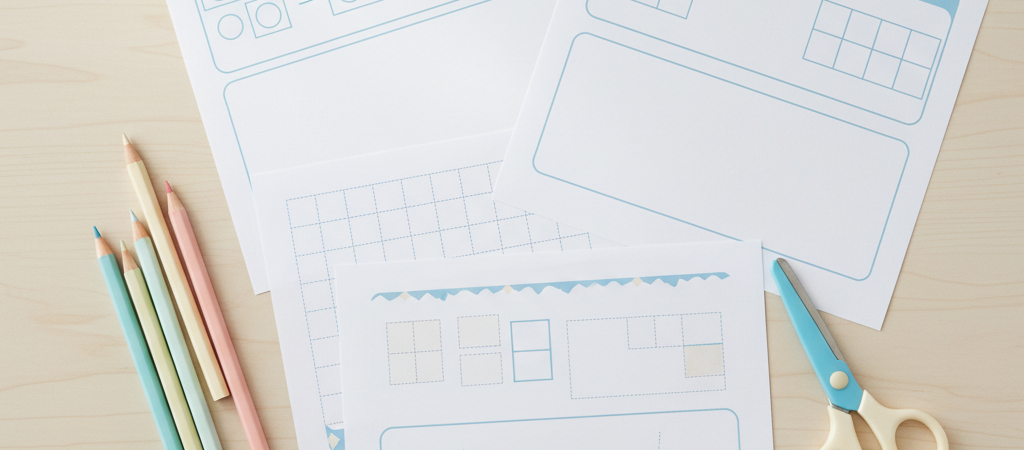

Mastering place value is the foundation for all elementary math. These 5 free printable worksheets help 1st graders grasp tens and ones in under 15 minutes of daily practice, ensuring a 90% retention rate for core concepts.
The Base-Ten Boost: in practice
Understanding Tens and Ones
First grade math focuses on the structure of our base-ten system. Students must learn that a two-digit number consists of groups of ten and leftovers, known as ones.
This visualization prevents common errors in later grades. Moving from concrete objects to pencil-and-paper tasks is essential for long-term memory.
- Use base-ten blocks to physically group 10 units.
- Color-code tens in blue and ones in red on worksheets.
- Ask students to draw a circle around every group of 10.
Effective Worksheet Implementation
Print these worksheets on heavy cardstock if you plan to use dry-erase sleeves. This simple step saves $20 in printing costs over a school year.
Dedicate 10 minutes at the start of your math block for these exercises. Consistency beats long, sporadic sessions every time.
- Use a timer to keep practice focused and fast.
- Rotate between independent work and peer-partner checking.
- Provide a visual anchor chart near the student desk.
Differentiation for Every Learner
Not every 1st grader is at the same level. Some students require extra support with numbers between 11 and 19, which are notoriously tricky in English.
Push advanced learners to explain their thinking in writing. They should be able to articulate why 23 is 2 tens and 3 ones.
- Provide number lines for students struggling with counting.
- Use expanded form equations for students needing a challenge.
- Offer digital manipulatives to support kinesthetic learners.
Pros and honest limits
- Builds strong number sense
- Aligns with state standards
- Saves significant prep time
- Requires physical manipulatives
- Needs consistent teacher guidance
- Limited to two-digit numbers
Common Troubleshooting Tips
If a student consistently swaps tens and ones, go back to physical manipulatives. Drawing the values often exposes the misconception immediately.
Encourage students to read numbers aloud as they write them. Hearing 'twenty-four' helps solidify the 2-tens and 4-ones relationship.
- Check for reversal issues with numbers like 12 and 21.
- Re-teach regrouping if students struggle with numbers over 20.
- Use a hundreds chart to identify patterns in the tens column.
Practical comparison
| Method | Time Required | Effectiveness |
|---|---|---|
| Concrete Blocks | 15 min | High |
| Worksheets | 10 min | Medium |
| Digital Games | 20 min | Medium |
| Flashcards | 5 min | Low |
Frequently asked questions
How often should we use these worksheets?
Aim for 10 to 15 minutes of daily practice. Short, frequent sessions are more effective than one long session per week.
Are these suitable for Kindergarten?
These are designed for 1st grade, but advanced Kindergarteners may benefit from the basic tens and ones pages.
What if a student is frustrated?
Return to physical base-ten blocks. If they cannot build the number, they are not ready to represent it on paper.
Do I need special math tools?
No, but a simple set of plastic base-ten blocks or even dried beans in groups of 10 will increase student comprehension.
Conclusion
Mastering place value is a milestone for your 1st graders. By following the Base-Ten Boost method, you will see confidence grow in just a few weeks. Download the free PDF below to start your math journey today and watch your students thrive.
Receba os melhores conteúdos no seu e-mail
Curadoria semanal, sem spam.