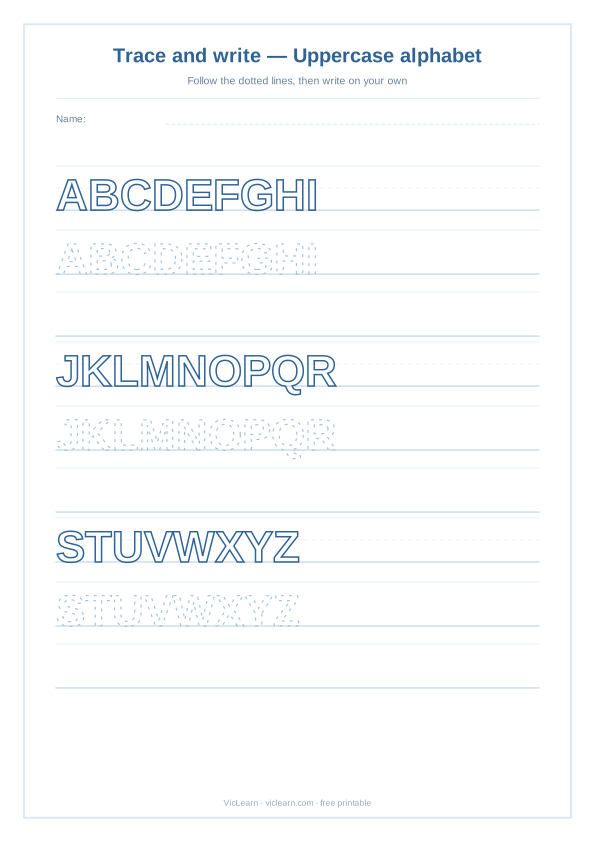
If you searched for Alphabet Tracing Worksheets A–Z — Free Printable PDF, you probably need something you can print in the next five minutes — not a lecture. Here it is, with the teaching notes underneath.
Type your child’s name and print a custom tracing worksheet in seconds — free, no sign-up.
Make my worksheet →
Everything here prints in black and white on plain A4, so there is no colour ink to burn through.
Download PDF (A4)
Download PNG
Print now
What is inside
Four ruled bands with model letters, a dotted line to trace and a free line to write independently.
How to use it
- Download the PDF and print it on A4 or US Letter paper (fit to page).
- For a whole class, print one copy and photocopy it — the lines stay crisp because the file is vector, not a photo.
- Laminate it or slip it into a plastic sleeve to reuse with dry-erase markers.
Free for classroom and home use. Please do not resell the file.
This Alphabet Tracing Worksheets A sheet is designed for one short session: print it, hand it over and expect it to be finished in about ten minutes. Below you will find what the child practices, how to run the activity, and five ways to reuse the same page.
What your child actually practices here
- Directionality: every stroke starts at the dot and follows the arrow, which is exactly the motor pattern schools ask for later.
- Letter formation from memory: the model line, the dotted line and the free line move the child from copying to writing alone.
- Line control: staying between the ruled bands is what makes handwriting legible, more than the shape of the letter itself.
- Left-to-right sweep: the eyes learn the reading direction while the hand works.
Best age range and how to adapt it
- Preschool: shorten the goal — half the page, no time pressure, and stop while the child is still enjoying it.
- Kindergarten: perfect fit; this is the level the sheet was designed for.
- Early elementary: raise the bar by adding a timer, a story about the picture, or a written sentence underneath.
What you need
- A4 or US Letter paper (plain 75g is enough — the file is vector, so it stays sharp)
- A pencil, or thick crayons for children under five
- Optional: a plastic sleeve or laminating pouch plus a dry-erase marker to reuse the sheet
A 15-minute plan you can follow today
- Minute 1-2: print the sheet and say out loud what you are going to do, so the child knows where the activity ends.
- Minute 3-10: the child works; you stay nearby but silent unless asked. Interrupting breaks concentration more than a wrong stroke does.
- Minute 11-13: review it together, pointing at one thing that came out well before anything to fix.
- Minute 14-15: put the sheet somewhere visible. Finished work on display is what makes the child ask for the next one.
Five ways to reuse the same sheet
- Laminate and repeat daily for a week; progress is obvious when you compare Monday to Friday.
- Write the same letter big on a board first, small on paper after.
- Ask for a word that starts with that letter at the end of each line.
- Trace first with a finger, then with a pencil — the motor memory is stronger.
- Use a different color per stroke to make direction visible.
Common mistakes (and the quick fix)
- Using thin pencils with very young children: a thicker pencil or crayon gives a more stable grip.
- Turning the activity into a test: no scores, no comparisons with siblings.
- Throwing the sheet away at the end: keeping a folder shows visible progress over weeks.
Frequently asked questions
Is this alphabet tracing worksheets a printable really free?
Yes. The PDF downloads directly, with no sign-up, no email and no watermark. You can use it at home and in the classroom.
Can I print it for my whole class?
Yes. Print one copy and photocopy it, or print as many as you need. The only restriction is reselling the file itself.
What paper size should I use?
The file is built for A4 and prints perfectly on US Letter as well — just keep the printer on “fit to page”.
Will it print well in black and white?
Yes. Everything is vector line work, so a plain black-and-white laser or inkjet printer gives a clean result.
Can I reuse the same sheet?
Put it inside a plastic sleeve or laminate it and use a dry-erase marker. One print then lasts for months.
If this sheet worked well, the same idea repeats across the whole VicLearn library: one clear objective per page, printed in seconds and finished before the child loses interest.
Everything included in this set
Each sheet below is part of the same set. Open any of them to print or download the PDF — no sign-up, no watermark.
Which level should I print?
Start one level below where the child is comfortable. Confidence first, difficulty second.
| Level | Best for | What to print first | Signs it is too hard |
|---|---|---|---|
| Pre-K (3–4) | Pencil control and thick strokes | The simplest sheet in the set | Grips hard or drifts off the line |
| Kindergarten (5) | Single letters and numbers | Dotted tracing with direction arrows | Reverses letters often |
| 1st grade (6) | Words and short sentences | Double-ruled line sheet | Letters escape the baseline |
| 2nd grade (7+) | Fluent and joined writing | Free practice sheet | Tires before finishing a row |
How to use these at home or in class
- Print one sheet, not the whole set. A single page finished beats five pages abandoned.
- Sit on the child’s non-writing side so your hand never blocks the model.
- Trace the first item together out loud, then let the child finish the row alone.
- Stop at the first sign of fatigue — 6 to 8 minutes is a full session at this age.
- Keep finished sheets in a folder; re-printing the same page in two weeks shows real progress.
Print checklist (30 seconds)
- Paper: plain A4 or US Letter, 90–120 g/m² so markers do not bleed through.
- Printer setting: “Actual size” / 100% — “Fit to page” shrinks the guide lines.
- Black & white is enough; save colour ink for the reward pages.
- Slide the page into a plastic sleeve to reuse it with a dry-erase marker.
Frequently asked questions
Are these alphabet tracing worksheets free printables free?
Yes. You can view, print and download the PDF with no sign-up and no watermark.
Can I use them in my classroom?
Yes — print them for your class or your own children. This set has 2 variations to rotate through the year.
How much practice per day?
Six to ten focused minutes a day beats one long session at the weekend.
Do I need a colour printer?
No. Every sheet is designed to print clearly in black and white.
Explore the topic
More in this topic
Get the complete pack of this set — free
One email, one link, all the sheets of this topic in a single PDF. No spam, unsubscribe in one click.
What you need to print this well
- Bright white printer paper (24 lb)Markers stop bleeding through at 24 lb / 90 g.
- Dry-erase pocketsTurn one printed sheet into unlimited practice.
- Triangular beginner pencilsFixes the grip before the handwriting habit sets.
- Laminator + pouchesFor the charts and cards you will reuse all year.
Links to Amazon. If you buy through them we earn a small commission at no extra cost — it keeps every sheet on this site free.
Want the printer-ready mega packs? See the printable packs.