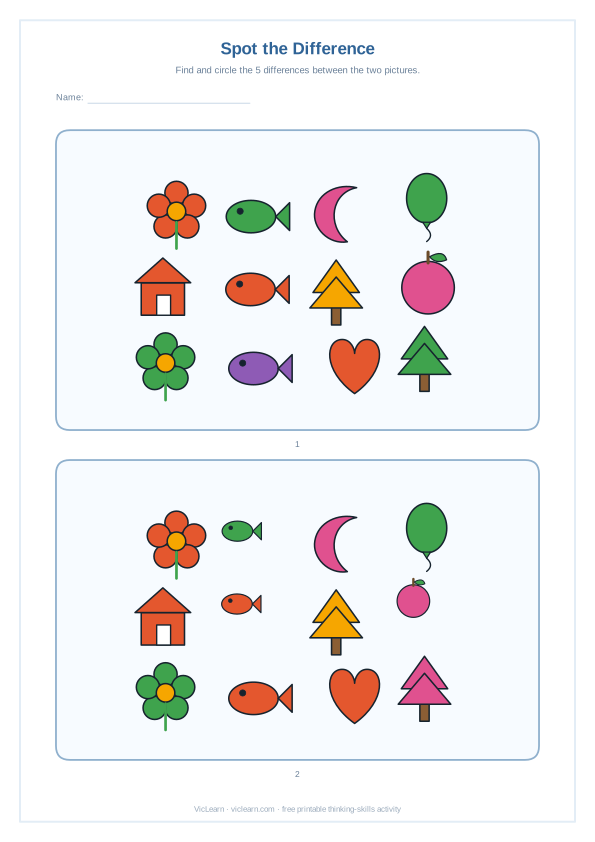

We tested Spot the Difference Printable for Kids — Ages 6–7 (Free PDF with Answer Key) with real kids before writing anything down, and the layout below is what survived — fewer instructions, more doing.
Everything here prints in black and white on plain A4, so there is no colour ink to burn through. Made for one printer and one child, not a classroom set.
Download PDF (A4)
Download PNG
Print now
What is inside
Two illustrated scenes side by side with a set number of differences to find and circle, plus the answer key on page two.
How to use it
- Download the PDF and print it on A4 or US Letter paper (fit to page).
- For a whole class, print one copy and photocopy it — the lines stay crisp because the file is vector, not a photo.
- Laminate it or slip it into a plastic sleeve to reuse with dry-erase markers.
Free for classroom and home use. Please do not resell the file.
Why this sheet works
Spot-the-difference looks like a time filler, but it trains visual discrimination — the exact skill a child uses to tell b from d, or 6 from 9. It also builds a search strategy: children who scan in order find more differences than children who stare at the middle of the page.
How to use it, step by step
- Set the rule first: circle the difference on the right-hand picture only.
- Teach one sweep — top-left to bottom-right, in bands, like reading.
- Ask them to say the difference out loud before circling it (“the cat lost a whisker”).
- Stop at the announced number instead of hunting forever; the count is on the sheet.
- Compare with the answer key together and talk about the ones they missed.
Three ways to make it harder (or easier)
- Easier: fold the page so only one band shows at a time.
- Harder: set a two-minute timer and count how many they find.
- Pairs: two children race on identical sheets, then explain their finds to each other.
Mistakes that ruin the activity
- Pointing at the area where a difference hides. The search is the whole exercise.
- Printing too small — at less than 100% the fine details vanish.
- Letting the child give up at the last one; that final difference is where the strategy is learned.
Age and level guide
| Age | What to expect | Time on task | Ready for more when |
|---|---|---|---|
| 3–4 | Needs an adult reading each instruction out loud | 5–8 minutes | The child points to the answer before you finish reading |
| 5–6 | Works alone in short bursts, asks to check | 8–12 minutes | Two sheets in a row with no help |
| 7–8 | Reads and solves independently | 12–18 minutes | Finishes early and looks bored |
| 9+ | Wants a rule to bend or a timer to beat | 15–20 minutes | Starts inventing their own version |
Print checklist (30 seconds)
- Paper: plain A4 or US Letter, 90–120 g/m² so felt-tip pens do not bleed through.
- Printer setting: “Actual size” or 100% — “Fit to page” shrinks the guides and margins.
- Black and white is enough; keep the colour ink for the pages the child chooses to colour.
- Print one copy first and check the margins before running a whole classroom set.
- Slide the finished sheet into a plastic sleeve to reuse it with a dry-erase marker.
Frequently asked questions
How many differences are there?
The number is printed on the sheet itself and repeated on the answer page.
Where is the answer key?
It is the last page of the PDF — print it separately and keep it aside.
Is it useful or just fun?
Both. Visual discrimination supports letter recognition and careful reading.
Explore the topic
More in this topic
Get the complete pack of this set — free
One email, one link, all the sheets of this topic in a single PDF. No spam, unsubscribe in one click.
What you need to print this well
- Bright white printer paper (24 lb)Markers stop bleeding through at 24 lb / 90 g.
- Dry-erase pocketsTurn one printed sheet into unlimited practice.
- Triangular beginner pencilsFixes the grip before the handwriting habit sets.
- Laminator + pouchesFor the charts and cards you will reuse all year.
Links to Amazon. If you buy through them we earn a small commission at no extra cost — it keeps every sheet on this site free.
Want the printer-ready mega packs? See the printable packs.