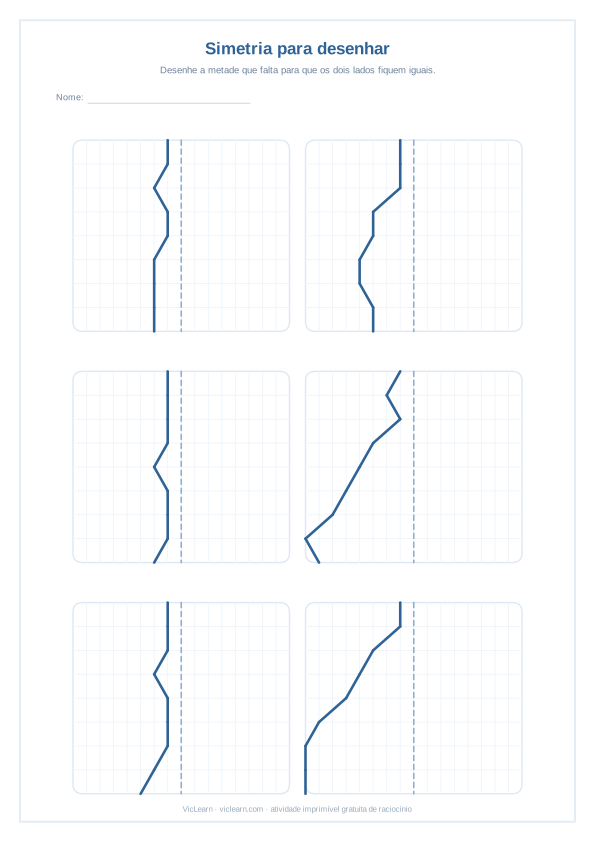

Skip the theory: Simetria para desenhar — raciocínio espacial — 8 a 9 anos (PDF grátis com gabarito) starts with the printable, then explains the skill it builds and how to extend it.
File the finished sheets by date. Comparing week one with week four says more than any grade. No login, no email, no watermark.
-
Tangram para imprimir e recortar — peças coloridas, desafios e gabarito (PDF grátis)
Seis páginas: as sete peças do tangram coloridas para recortar, 14 cartas-desafio em silhu… -
Desafios de lógica para crianças para imprimir — 10 a 12 anos (PDF grátis com gabarito)
Um desafio de dedução com pistas escritas, grade para marcar e linhas para a resposta fina… -
Desafios de raciocínio matemático — 10 a 12 anos (PDF grátis com gabarito)
Desafios em que cada desenho vale um número e a criança deduz o valor que falta. Inclui ga… -
Simetria para desenhar — raciocínio espacial — 10 a 12 anos (PDF grátis com gabarito)
Grades de simetria com metade da figura desenhada e um eixo pontilhado para completar a ou…
Baixar PDF (A4)
Baixar PNG
Imprimir agora
O que vem dentro
Grades de simetria com metade da figura desenhada e um eixo pontilhado para completar a outra metade.
Como usar
- Baixe o PDF e imprima em papel A4 (opção “ajustar à página”).
- Para a turma toda, imprima uma via e tire cópias: o arquivo é vetorial, então as linhas não ficam serrilhadas.
- Plastifique ou coloque num saco plástico para reutilizar com caneta de quadro branco.
Uso livre em casa e na escola. Não revenda o arquivo.
- Sequências e padrões para imprimir — 8 a 9 anos (PDF grátis com gabarito)
- Atividades de pensamento crítico — qual não pertence? — 8 a 9 anos (PDF grátis com gabarito)
- Desafios de raciocínio matemático — 6 a 7 anos (PDF grátis com gabarito)
- Simetria para desenhar — raciocínio espacial — 6 a 7 anos (PDF grátis com gabarito)
Everything included in this set
Each sheet below is part of the same set. Open any of them to print or download the PDF — no sign-up, no watermark.
- Simetria para desenhar — raciocínio espacial — 6 a 7 anos (PDF grátis com gabarito)Open sheet →
- Simetria para desenhar — raciocínio espacial — 10 a 12 anos (PDF grátis com gabarito)Open sheet →
- Simetria para desenhar — raciocínio espacial — 4 a 5 anos (PDF grátis com gabarito)Open sheet →
Which level should I print?
Start one level below where the child is comfortable. Confidence first, difficulty second.
| Level | Best for | What to print first | Signs it is too hard |
|---|---|---|---|
| Pre-K (3–4) | Pencil control and thick strokes | The simplest sheet in the set | Grips hard or drifts off the line |
| Kindergarten (5) | Single letters and numbers | Dotted tracing with direction arrows | Reverses letters often |
| 1st grade (6) | Words and short sentences | Double-ruled line sheet | Letters escape the baseline |
| 2nd grade (7+) | Fluent and joined writing | Free practice sheet | Tires before finishing a row |
How to use these at home or in class
- Print one sheet, not the whole set. A single page finished beats five pages abandoned.
- Sit on the child’s non-writing side so your hand never blocks the model.
- Trace the first item together out loud, then let the child finish the row alone.
- Stop at the first sign of fatigue — 6 to 8 minutes is a full session at this age.
- Keep finished sheets in a folder; re-printing the same page in two weeks shows real progress.
Print checklist (30 seconds)
- Paper: plain A4 or US Letter, 90–120 g/m² so markers do not bleed through.
- Printer setting: “Actual size” / 100% — “Fit to page” shrinks the guide lines.
- Black & white is enough; save colour ink for the reward pages.
- Slide the page into a plastic sleeve to reuse it with a dry-erase marker.
Frequently asked questions
Are these simetria desenhar raciocinio espacial printables free?
Yes. You can view, print and download the PDF with no sign-up and no watermark.
Can I use them in my classroom?
Yes — print them for your class or your own children. This set has 4 variations to rotate through the year.
How much practice per day?
Six to ten focused minutes a day beats one long session at the weekend.
Do I need a colour printer?
No. Every sheet is designed to print clearly in black and white.
Why this sheet works
A logic puzzle is one of the few school-style tasks where being stuck is the point. The child has to hold two or three facts in their head at once, test a guess and drop it when it fails. That habit — try, check, revise — transfers directly to word problems, which is where most maths marks are lost.
How to use it, step by step
- Read the puzzle out loud twice. The second reading is where the details land.
- Underline the facts, one per line, before touching the answer boxes.
- Encourage a written guess. A wrong guess on paper is easier to fix than one held in the head.
- When they are stuck, ask “what do you already know for sure?” instead of giving a hint.
- After solving, ask them to explain how they knew. Explaining doubles what sticks.
Three ways to make it harder (or easier)
- Easier: give one fact away for free at the start.
- Harder: remove the answer boxes and ask for the reasoning in full sentences.
- Team version: two children each get half the clues and must talk to solve it.
Mistakes that ruin the activity
- Rescuing too early. Thirty seconds of silence is not failure, it is thinking.
- Doing several puzzles in a row; one solved and explained beats four half-done.
- Judging by speed. The slow solver who can explain the answer understood more.
Age and level guide
| Age | What to expect | Time on task | Ready for more when |
|---|---|---|---|
| 3–4 | Needs an adult reading each instruction out loud | 5–8 minutes | The child points to the answer before you finish reading |
| 5–6 | Works alone in short bursts, asks to check | 8–12 minutes | Two sheets in a row with no help |
| 7–8 | Reads and solves independently | 12–18 minutes | Finishes early and looks bored |
| 9+ | Wants a rule to bend or a timer to beat | 15–20 minutes | Starts inventing their own version |
Frequently asked questions
What if my child cannot solve it?
Re-read the clues together and ask what is certain. Stop before frustration and return the next day.
Are the answers included?
Yes, on the last page of the PDF.
How often should we do these?
Two or three a week is plenty; they are short but mentally heavy.
Explore o tema
Mais deste tema
Receba o pacote completo deste conjunto — grátis
Um e-mail, um link, todas as folhas do tema num único PDF. Sem spam, cancela quando quiser.
O que você precisa para imprimir bem
- Papel sulfite 90 gCom 90 g a canetinha para de atravessar a folha.
- Plásticos apagáveisUma folha impressa vira prática infinita.
- Lápis triangularCorrige a pegada antes de o hábito se fixar.
- Plastificadora e polasealPara os quadros e cartões que você reusa o ano todo.
Links da Amazon. Se você comprar por eles ganhamos uma pequena comissão sem custo extra — é o que mantém todas as folhas gratuitas.
Quer os mega pacotes prontos para imprimir? Veja os pacotes imprimíveis.